
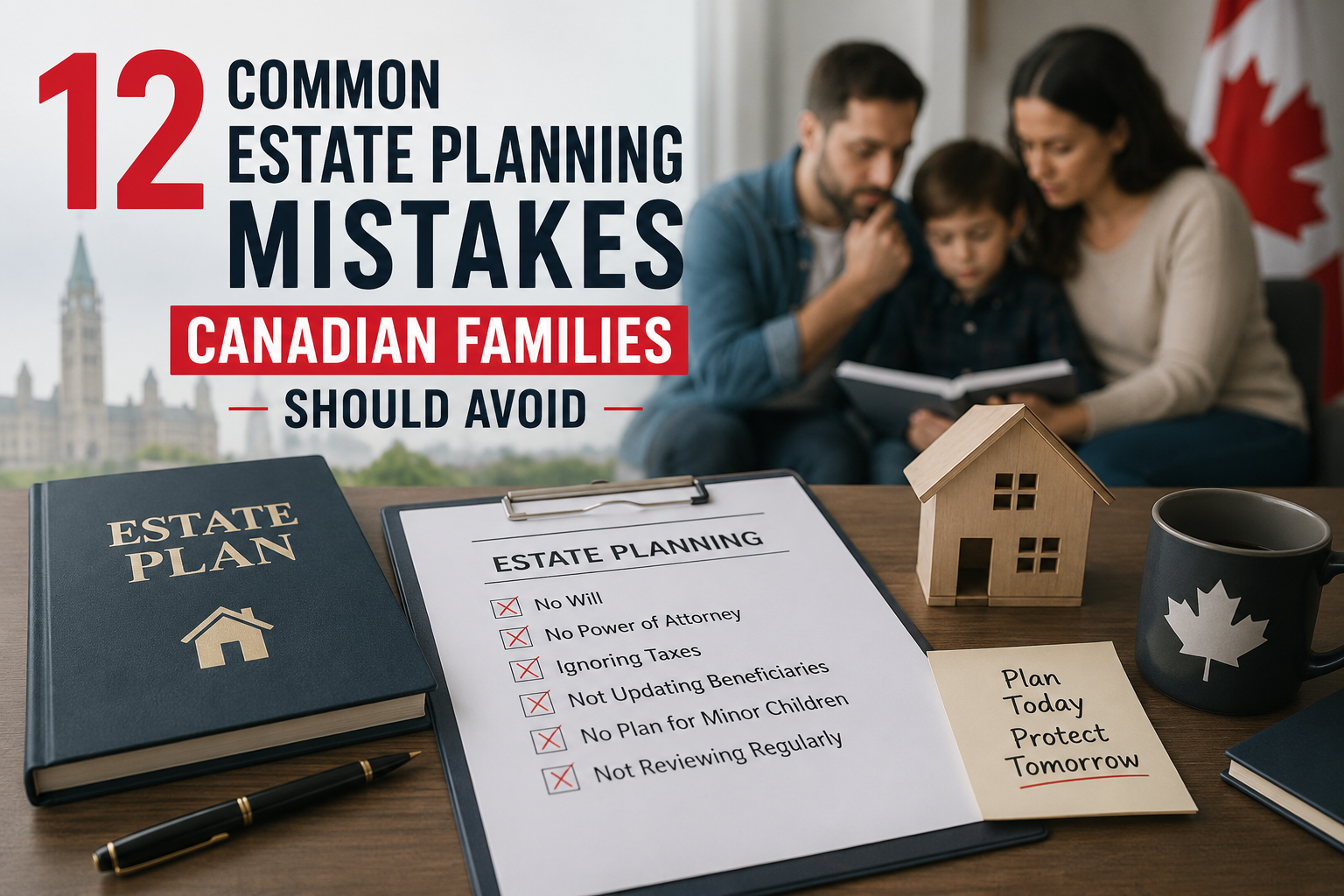

Estate planning isn’t just for the wealthy, it’s for anyone who wants to protect their family, their assets, and their wishes. Yet many Canadian families put it off, do it incorrectly, or assume it’s already taken care of. The result is often unnecessary stress, unexpected costs, and family conflict at the worst possible time.
Below are the most common estate planning mistakes Canadians make, along with practical guidance on how to avoid them.

Mistake 1: Not Having a Valid Will
If you die without a valid will in Canada, you die “intestate,” and your estate is distributed according to the intestacy laws of your province or territory rather than your own wishes. These rules vary across the country, but generally follow a fixed formula based on family relationships.
How intestacy affects spouses, children, and unmarried partners
- Married spouses typically receive a preferential share of the estate, with the remainder split with children, the exact split depends on your province.
- Common-law partners are not automatically recognized as spouses under intestacy rules in most provinces, which can leave a long-term partner with no legal claim to the estate.
- Minor children may have their inheritance held by the province’s Public Guardian and Trustee (or equivalent) until they reach the age of majority, rather than being managed the way you would have chosen.
- Blended families, stepchildren, and unmarried couples are especially vulnerable to unintended outcomes under intestacy.
Why every adult should have a legally valid will
A properly drafted, signed, and witnessed will (meeting your province’s requirements) ensures your assets go where you want them to go, lets you choose your executor and guardians for minor children, and can significantly reduce delays, legal costs, and family disputes.
Mistake 2: Failing to Update Your Will
- Marriage: In several provinces, marriage does not automatically revoke a prior will (rules vary by province), but it’s essential to review your will when you marry to reflect new intentions.
- Divorce or separation: Divorce may automatically revoke gifts to a former spouse in some provinces, but not in all , and separation alone often has no automatic legal effect on a will.
- Births, deaths, and changes in family circumstances should always trigger a will review.
- Changes in assets or inheritance , a new property, business, inheritance, or significant change in net worth should prompt an update.
Reviewing your will regularly
A good rule of thumb is to review your will every three to five years, or immediately after any major life event.
How outdated wills create unintended consequences
An outdated will can leave assets to an ex-spouse, omit new children, name an executor who has since died or become unable to serve, or fail to reflect your current wishes altogether , leading to disputes and unnecessary legal costs for your loved ones.
Mistake 3: Ignoring Tax Planning on Death

Canada does not have an inheritance tax or estate tax in the way the UK does. Instead, your estate can face two major cost centres: capital gains tax and provincial probate fees (estate administration tax).
Understanding the Canadian tax rules
- At death, you’re generally deemed to have disposed of your capital property at fair market value, which can trigger capital gains tax on assets like investments, rental properties, and cottages , unless they transfer to a surviving spouse or common-law partner (which can defer the tax).
- Registered accounts like RRSPs and RRIFs are typically fully taxed as income in the year of death unless rolled over to a spouse, common-law partner, or financially dependent child or grandchild.
- Your principal residence is generally exempt from capital gains tax.
Common tax-saving opportunities
- Spousal rollovers to defer capital gains and registered account taxation.
- Charitable donations, which generate tax credits that can offset income in the year of death.
- Life insurance, which passes tax-free to named beneficiaries and can help cover the tax bill on other assets.
Probate fees
Provincial probate fees (called Estate Administration Tax in Ontario, for example) are charged on the value of assets passing through your estate and vary by province. Strategies such as joint ownership, beneficiary designations, and trusts can help reduce assets subject to probate , but each comes with trade-offs that should be considered carefully.
Professional tax planning
An accountant or estate planning professional can help structure your affairs to legally minimize the tax and probate costs your estate will face.
Mistake 4: Not Setting Up a Power of Attorney
A Power of Attorney is a legal document that lets you appoint someone to make decisions on your behalf if you become unable to do so. In Canada, this generally comes in two forms (terminology varies slightly by province).
- Power of Attorney for Property (Financial Affairs): Allows your appointed attorney to manage your finances, property, and legal affairs.
- Power of Attorney for Personal Care (Health and Welfare): Allows your appointed attorney to make decisions about your healthcare, living arrangements, and personal care.
Risks of losing mental capacity without a POA
Without a valid POA in place, your family may be forced to apply to the court for guardianship , a process that can be slow, expensive, and stressful, especially during a medical crisis.
Mistake 5: Failing to Consider Trusts
A trust is a legal arrangement where a trustee holds and manages assets on behalf of one or more beneficiaries, according to terms you set out.
Situations where trusts may be beneficial
- Providing for minor children until they reach an appropriate age.
- Protecting a vulnerable beneficiary, such as a family member with a disability (a Henson trust, for example, can help preserve eligibility for provincial disability benefits).
- Managing assets for a beneficiary who isn’t ready or able to manage a lump sum inheritance.
- Blended family situations, where you want to provide for a spouse while preserving assets for children from a previous relationship.
Tax and asset protection considerations
Trusts can offer creditor protection and, in some cases, income-splitting or tax-deferral opportunities, though Canadian trust taxation rules are complex and have tightened in recent years. Professional advice is essential before setting one up.
Mistake 6: Not Planning for Digital Assets

Digital assets are often overlooked, yet they make up a growing share of most people’s lives and finances.
- Online banking and investment accounts , your executor will need access information to locate and manage these.
- Cryptocurrency , without your private keys or wallet access details, crypto holdings can be permanently lost.
- Social media accounts , decide whether you want accounts memorialized, deleted, or maintained.
- Digital investments and subscriptions , online brokerages, domain names, and business accounts should be documented.
- Password management , a secure, up-to-date record of key accounts and credentials (stored safely and referenced in your estate plan) can save your executor significant time and difficulty.
Mistake 7: Overlooking Business Succession Planning
If you own a business, your estate plan needs to address what happens to it.
- Family businesses , succession planning ensures leadership and ownership transition smoothly, avoiding disputes among family members.
- Sole traders , without a plan, a sole proprietorship may simply cease to operate on your death, affecting employees, clients, and value for your estate.
- Partnerships , a buy-sell agreement can determine what happens to your share if you die or become incapacitated.
- Limited companies , shareholder agreements, share structures, and life insurance funding arrangements all need to be considered.
- Protecting business continuity ensures the business retains value and can continue operating, or be sold, without unnecessary disruption.
Mistake 8: Assuming Joint Ownership Solves Everything
Joint ownership is often used as a simple probate-planning tool, but it carries real risks if not properly understood.
- Joint tenancy with right of survivorship means an asset passes automatically to the surviving owner outside of your will , useful for spouses, but risky when used with adult children, as it can expose the asset to that child’s creditors, marital claims, or unequal treatment among siblings.
- Tenants in common means each owner holds a distinct share, which passes through their estate (and will) rather than automatically to the other owner.
- Property ownership implications , adding a child to title can trigger unintended tax consequences and doesn’t always guarantee your original intentions are honoured.
- Passing property efficiently requires understanding which ownership structure actually matches your goals , joint ownership isn’t a substitute for proper estate planning.
Mistake 9: Forgetting Beneficiary Nominations on Registered Accounts and Insurance
Why registered accounts often sit outside your estate
RRSPs, RRIFs, TFSAs, and pension plans typically pass directly to the named beneficiary, bypassing your will and probate entirely , which means your will has no effect on where these assets go.
Keeping nomination forms updated
An outdated beneficiary designation (naming a former spouse, for example) will generally override what your will says, so these forms should be reviewed after every major life change.
Life insurance beneficiary designations
Life insurance proceeds also pass directly to named beneficiaries outside of probate in most cases, making it critical to keep these designations current and consistent with your overall estate plan.
Mistake 10: Not Discussing Your Plans with Your Family

Preventing misunderstandings
Silence often causes more conflict than the decisions themselves. Explaining your reasoning , even briefly , can prevent confusion and hurt feelings later.
Reducing family conflict
Estate disputes frequently arise not from what was decided, but from family members feeling blindsided.
Managing expectations
Clear, early communication helps set realistic expectations for beneficiaries, executors, and guardians alike.
Communicating sensitive decisions
Unequal inheritances, choice of executor, or care arrangements for a vulnerable family member are easier to accept when explained directly, rather than discovered after death.
Mistake 11: Keeping Poor Records
- Missing financial documents can delay or complicate estate administration significantly.
- Lost wills may force your estate into intestacy, even if a valid will once existed.
- Property ownership records need to be accessible and accurate, including mortgage and title details.
- Investment documentation should be organized so your executor can locate and value all assets.
- Organizing estate information in one secure, known location (and telling your executor where to find it) is one of the simplest ways to ease the burden on your family.
Mistake 12: Trying to Do Everything Without Professional Advice
When DIY estate planning becomes risky
Template wills and online tools can work for very simple estates, but they often fail to account for provincial legal requirements, tax nuances, or family complexity.
Complex family situations
Blended families, dependents with disabilities, business ownership, or cross-provincial or international assets all significantly raise the risk of a DIY plan falling short.
Tax implications
Capital gains, registered account taxation, and probate fees can have major financial consequences if not properly planned for.
Choosing qualified legal and financial professionals
A licensed estate lawyer, accountant, and financial planner working together can help ensure your plan is legally valid, tax-efficient, and reflective of your actual wishes.
How to Avoid These Estate Planning Mistakes: Practical Checklist
- Create a legally valid will that meets your province’s requirements
- Review your estate plan every few years, or after major life events
- Set up both types of Power of Attorney (property and personal care)
- Consider trusts where appropriate for your family situation
- Plan proactively for capital gains tax and probate fees
- Update beneficiary designations on registered accounts and insurance regularly
- Organize and securely store important documents
- Discuss your wishes with your family before they need to find out on their own
- Seek professional legal, tax, and financial advice when your situation is anything but simple
Estate Planning Checklist for Canadian Families

 Will completed and properly executed
- Executor(s) appointed
- Guardians chosen (if applicable)
- Powers of Attorney (property and personal care) in place
- Trusts reviewed and considered where appropriate
- RRSP/RRIF/TFSA and pension beneficiary designations updated
- Life insurance beneficiaries reviewed
- Property ownership structure checked (joint tenancy vs. tenants in common)
- Tax and probate planning completed
- Digital assets documented
- Estate documents stored securely and executor informed of location
Protecting What Matters Most
Estate planning is about protecting your family as much as your assets. Many of the most costly mistakes , an outdated will, a missing Power of Attorney, an unclear beneficiary designation , are entirely preventable with timely planning and regular reviews.
A well-structured estate plan can minimize legal complications, reduce unnecessary tax and probate costs, and ensure your wishes are actually carried out. Reviewing your arrangements today, rather than waiting for “someday,” can provide lasting security and peace of mind for the people who matter most.









Leave a comment