


Ask most Canadians how to have a comfortable retirement, and they’ll talk about saving more, investing wisely, and hoping the markets cooperate. Ask a financial planner the same question, and you’ll get a different answer: it isn’t just how much you’ve saved, but how much of it you actually get to keep.
That distinction matters more than most people realize. Two retirees can arrive at 65 with the exact same $800,000 nest egg, the same CPP and OAS entitlements, and the same spending needs and still end up with noticeably different amounts of after-tax income for the rest of their lives, simply because of the order and manner in which they draw down their accounts.
There’s a widespread assumption that retirement automatically means a lighter tax bill. It’s an understandable belief after all, your paycheque disappears, and with it the payroll deductions that used to eat into every deposit. But retirement income doesn’t stop being taxable; it just changes shape. CPP and OAS are taxable. RRIF withdrawals are taxable, often at the same marginal rates you paid while working. And once income-tested benefits like OAS and the Guaranteed Income Supplement enter the picture, a poorly timed withdrawal can trigger clawbacks that make the true cost of that withdrawal far higher than the tax bracket alone would suggest.
The retirees who fare best aren’t necessarily the ones who saved the most, they’re the ones who understood how each dollar would be taxed before they touched it. Draw too heavily from a RRIF in your late sixties, and you might push yourself into a higher bracket, trigger the OAS recovery tax, or lose part of the Guaranteed Income Supplement you were counting on. Do it carelessly for long enough, and a retirement fund that should have lasted thirty years can run dry early not because the money wasn’t there, but because too much of it went to tax that better planning could have avoided.
This guide walks through the mechanics of Canada’s retirement income system CPP, OAS, GIS, RRSPs, RRIFs, TFSAs, and more and then turns to the strategies that make the real difference: the order in which you draw down your accounts, when it makes sense to delay government benefits, how to avoid the OAS clawback, and how couples and business owners can plan around the specific tools available to them. None of it requires guesswork or a finance degree. It requires knowing the rules, and using them deliberately.
1. Why Tax Efficiency Matters During Retirement

By the time most Canadians reach retirement, their income no longer comes from a single, tidy paycheque. It arrives instead from a patchwork of sources CPP, OAS, maybe a workplace pension, RRIF withdrawals, TFSA withdrawals, non-registered investment income, and for some, rental income or part-time work. Each of these is taxed under its own set of rules. Some are fully taxable. Some are entirely tax-free. Some are taxable but come with special credits attached. And some, like GIS, aren’t taxed at all, but shrink if your other income rises.
That complexity is exactly why tax efficiency deserves as much attention as investment performance. A retiree who earns a solid average return but withdraws carelessly, paying full marginal tax on money that could have been drawn more strategically, may end up worse off than a retiree with more modest returns and a thoughtful withdrawal plan. The difference isn’t in what the market gave you. It’s in how much of it you were allowed to keep.
Three forces make this even more pressing over a twenty- or thirty-year retirement. The first is longevity: Canadians are living longer than ever, and a couple retiring today at 65 has a real chance that one of them will still be alive in their mid-nineties. That’s a long time for a tax-inefficient withdrawal pattern to compound its damage. The second is inflation, which quietly erodes the purchasing power of a fixed pension or a level withdrawal amount, meaning your income needs tend to rise over time rather than stay flat. The third is health. Canadian life expectancy currently sits at roughly 80 years for men and 84 for women, yet Statistics Canada figures suggest the average Canadian can only expect to spend around 70 of those years in good health leaving a real gap where medical and care-related costs become far less predictable, from dental work to home care to a long-term care room, which averages a little over $3,000 a month in Canada. The Conference Board of Canada has estimated the average Canadian senior spends roughly $12,000 a year on healthcare, and that figure only tends to climb with age. These costs have an uncomfortable habit of arriving exactly when you may have the least appetite for a large, badly timed taxable withdrawal.
None of this means retirement is destined to be a tax trap. It means the opposite: because so much is within your control which account you draw from, when you start CPP and OAS, how you structure withdrawals with a spouse, a retiree who plans deliberately can often keep meaningfully more of their income than one who simply withdraws whatever seems convenient in the moment.
The idea carries through the rest of this guide: retirement security isn’t only about how much you’ve saved. It’s about how much of what you’ve saved you actually get to spend. Every dollar kept out of the tax system’s reach is a dollar that keeps compounding a dollar that helps your money outlast you, rather than the other way around.
2. Understanding Canada’s Retirement Income Sources

Retirement income in Canada is built from six broad categories, each governed by its own rules around taxation, flexibility, and how it interacts with everything else. Understanding what each one is and isn’t is the foundation everything else in this guide builds on.
Government Benefits
Canada Pension Plan (CPP)
CPP is the benefit most working Canadians pay into throughout their careers, and the amount you receive is tied directly to how much you contributed and for how long. For 2026, the maximum monthly CPP retirement pension at age 65 sits at $1,507.65, though the average new retiree collects closer to $925 a reminder that relatively few Canadians contribute the maximum for the full contributory period required to reach the top amount. CPP is fully taxable income, and it offers real flexibility on timing: you can start collecting any time between age 60 and 70, with your monthly payment permanently reduced for starting early or increased for starting late, a decision covered in detail in Section 7.
Old Age Security (OAS)
OAS works differently. Rather than being tied to contributions, it’s based on Canadian residency generally 40 years after age 18 for the full amount, with a partial pension available to those with at least 10 years of residency. OAS begins at 65 (there’s no early option, only the choice to defer up to age 70 for a permanent increase), and it’s fully taxable. It’s also the benefit most exposed to the income-tested recovery tax discussed in Section 8 the so-called OAS clawback which makes the timing of your other income especially important once OAS enters the picture.
Guaranteed Income Supplement (GIS)
GIS exists for a different purpose: topping up the incomes of lower-income seniors who already receive OAS. It’s entirely tax-free, but it comes with the steepest income test in the entire system the benefit is reduced by roughly fifty cents for every dollar of other net income (OAS itself excluded), which means even a modest RRIF withdrawal or part-time job can meaningfully erode a GIS entitlement. For retirees who qualify, protecting GIS is often a bigger planning priority than anything else in this guide.
Registered Accounts
RRSP
A Registered Retirement Savings Plan defers tax rather than eliminating it: contributions are deducted from taxable income when you make them, investments grow tax-free inside the plan, and withdrawals are fully taxed as income whenever they’re taken. For 2026, the contribution limit is the lesser of 18% of your prior year’s earned income or $33,810. The RRSP’s real usefulness in retirement comes down to timing because you control when withdrawals happen, at least until age 71, you have genuine discretion over which tax year, and which tax bracket that income lands in.
RRIF
A Registered Retirement Income Fund is what an RRSP becomes: by law, it must convert by the end of the year you turn 71. From that point on, the government requires a minimum withdrawal each year, calculated as a percentage of the account’s value that climbs steadily with age, from 5.28% at 71 to 20% at 95 and beyond. There’s no upper limit on how much you can withdraw, only a floor, and every dollar withdrawn mandatory or not is fully taxable. Section 6 covers the RRIF withdrawal schedule and how to manage it in real detail.
Tax-Free Accounts
TFSA
The Tax-Free Savings Account flips the RRSP’s logic: contributions aren’t deductible, but growth and withdrawals are entirely free of tax, and critically for retirees TFSA withdrawals don’t count as income for the purposes of OAS, GIS, or any other income-tested benefit. For 2026, the annual contribution limit is $7,000, and anyone who has been a Canadian resident and at least 18 since the program’s 2009 launch, and has never contributed, has accumulated $109,000 of lifetime room. Because of its unique benefit-neutral status, the TFSA plays a starring role throughout this guide, and Section 5 is devoted to it entirely.
Employer Pension Plans

Defined Benefit Pension
A defined benefit (DB) pension promises a specific monthly payment for life, calculated from a formula based on salary and years of service, with the employer and the plan itself bearing the investment risk. DB pension income is fully taxable, but it qualifies for the pension income tax credit and, importantly, for pension income splitting with a spouse at any age, a strategy covered fully in Section 9.
Defined Contribution Pension
A defined contribution (DC) pension instead promises a contribution amount, not an outcome: you and your employer contribute to an individual account, and your eventual retirement income depends on how those investments perform. At retirement, DC savings are typically transferred into a vehicle very similar to an RRSP or RRIF, often a locked-in account converted to a life income fund and taxed the same way RRIF withdrawals are.
Non-Registered Investments
Money held outside any registered plan is taxed the least favourably at first glance, and the most favourably in the details. Interest income is fully taxable at your marginal rate. Canadian dividends benefit from the dividend tax credit, which can make them meaningfully cheaper to receive than an equivalent amount of interest or salary. And capital gains currently taxed on only half of the gain are often the lightest-taxed income source available to a retiree, which is why the order in which non-registered assets are sold matters as much as what’s held inside the account, a topic Section 10 explores in depth.
Other Income
Retirement rarely means the complete end of earned income. Rental income from an investment property is taxed as ordinary income after deducting eligible expenses, and it’s one of the more demanding sources to plan around because it doesn’t pause just because you’d like a lower-income year. Business income, for retirees who keep a consulting practice or small business running past 65, is taxed similarly, though incorporated business owners have considerably more flexibility, explored fully in Section 13. And part-time or contract employment income is taxed exactly as it was during your working years, with the added wrinkle that it can affect GIS eligibility more aggressively than most retirees expect.
At a Glance: How Each Income Source Behaves
| Income Source | Taxable? | Flexibility | Best Used For |
|---|---|---|---|
| CPP | Fully taxable | Low start date is your main lever (60–70) | A reliable, inflation-indexed income floor |
| OAS | Fully taxable | Low to moderate deferrable to 70 | Base income; watch clawback exposure |
| GIS | Tax-free | Very low income-tested | Supplementing genuinely low-income years |
| RRSP | Tax-deferred; fully taxed on withdrawal | High until age 71 | Timing withdrawals into lower-income years |
| RRIF | Fully taxable | Moderate mandatory minimum, no maximum | Ongoing income after age 71 |
| TFSA | Tax-free | Very high | Topping up income without touching brackets or benefits |
| DB Pension | Fully taxable | Low fixed amount, but splittable | Predictable lifetime income |
| DC Pension / LIF | Fully taxable | Moderate min/max withdrawal bands | Market-linked retirement income |
| Non-Registered | Varies by income type | Very high | Flexible, often lightly-taxed supplementary income |
| Rental Income | Fully taxable after expenses | Low | Supplementary cash flow, lower liquidity |
| Business Income | Fully or corporately taxed | Moderate to high if incorporated | Continued earned income; splitting via a corporation |
| Part-Time Employment | Fully taxable | Low to moderate | Bridging income; watch effect on GIS |
3. How Retirement Income Is Taxed in Canada
Every dollar of retirement income you receive passes through the same progressive tax system that applied throughout your working life. Canada taxes income in layers, with each additional dollar taxed at a rate that depends on which bracket it falls into, not your income as a whole. For 2026, the federal brackets run from 14% on the first $58,523 of taxable income, up through 20.5%, 26%, and 29%, to a top federal rate of 33% above $258,482. On top of that sits provincial tax, which varies considerably by province, an Ontario resident, for example, pays provincial rates from 5.05% up to 13.16%, plus a surtax at higher incomes that can push the combined federal-provincial top marginal rate above 53%. A retiree in Alberta, with a flat 10% provincial rate and no provincial sales tax, faces a meaningfully lighter combined burden at the same income level than a retiree in Ontario or Quebec.
This is the single most important idea in retirement tax planning: your marginal rate, the rate on your next dollar of income, is what determines the cost of any withdrawal decision, not your average rate. A retiree sitting comfortably in the second federal bracket who takes an unusually large RRIF withdrawal in one year may push a portion of that withdrawal into a much higher bracket, even though their average tax rate for the year still looks moderate. Spread across two or three years instead, the same total withdrawal might never leave the lower bracket at all.
Two credits are worth understanding well before you touch a retirement account. The age amount is a federal non-refundable credit available to anyone 65 or older, worth up to $9,208 in 2026 (translating to roughly $1,289 in reduced federal tax), though it shrinks once net income passes $46,432 and disappears entirely at higher incomes. The pension income amount is smaller but often overlooked: it applies to the first $2,000 of eligible pension income, including RRIF withdrawals once you’re 65, or DB pension income at any age and notably, that $2,000 threshold hasn’t been increased since 1988, which is exactly the kind of detail that makes converting a portion of an RRSP to a RRIF before 71 worth considering, purely to start claiming the credit a few years earlier.
The other essential distinction is between taxable and tax-free income. CPP, OAS, RRSP and RRIF withdrawals, and most pension income all count toward your net income the figure used not just for your tax bracket, but for GIS eligibility and the OAS clawback threshold. TFSA withdrawals, by contrast, never appear on that line at all. That single difference is why so much of this guide keeps returning to the TFSA: it’s one of the only levers available to a retiree that adds spendable income without adding a single dollar to the number the government uses to means-test everything else.
Because withdrawal timing determines which bracket a dollar lands in, and because that bracket then ripples into clawbacks and credits well beyond the tax return itself, the sections that follow build toward a single goal: spreading retirement income across years and account types so that as much of it as possible stays in the lowest brackets available to you.
4. Create a Tax-Efficient Withdrawal Strategy

If there’s one section of this guide worth reading twice, it’s this one. Everything discussed so far tax brackets, credits, the different treatment of each income source exists to inform a single practical decision made every year of retirement: which account do I draw from first?
The textbook answer, and a reasonable starting point for many retirees, follows a fairly predictable sequence. Non-registered investments come first, because they’ve already been taxed once the original contribution came from after-tax income and because the capital gains and dividends inside them are taxed more lightly than ordinary income. RRSP and RRIF withdrawals come next, since they’re fully taxable and, left alone, only grow into a larger mandatory-withdrawal problem once you reach 71. The TFSA comes last, since it’s the only account that generates no tax and doesn’t affect a single government benefit, making it the ideal reserve for large one-off expenses, emergencies, or years when your other income is already pushing into a higher bracket.
But “textbook” and “right for you” aren’t always the same thing, and the sequence above is a starting assumption, not a rule. Four factors regularly change the ideal order.
The first is your current tax bracket relative to your likely future bracket. A retiree in their early sixties with a paid-off home, no CPP or OAS yet, and a large RRSP may actually be sitting in an unusually low tax bracket arguably the lowest they’ll see for the rest of their life. Drawing down the RRSP earlier than “necessary” in years like this, even ahead of non-registered accounts, can make sense specifically because those withdrawals are being taxed at a rate that may never be this low again once CPP, OAS, and mandatory RRIF withdrawals all arrive at once.
The second is age, particularly the countdown to 71. Every year an RRSP balance keeps growing untouched is a year that compounds the size of the mandatory RRIF withdrawal you’ll eventually face, and because that minimum percentage climbs with age, a large RRSP left alone until 71 can force uncomfortably large taxable withdrawals in your eighties and nineties exactly when you may most value predictability rather than a bigger tax bill.
The third is government benefits, especially the OAS clawback threshold. Keeping early, modest RRSP withdrawals in your sixties can hold your eventual RRIF balance and therefore your mandatory withdrawals later below the level that would trigger the clawback in your seventies and beyond. That’s a meaningfully different calculation than simply asking which account is “most tax-efficient” in isolation.
The fourth is your estate goals. Money left in an RRSP or RRIF at death is generally taxed as if it were withdrawn all at once on your final tax return (aside from a spousal rollover), often at the highest marginal rate a poor outcome for anyone who intends to leave money to children or a charity. A retiree who doesn’t expect to need all of their savings may deliberately draw down registered accounts faster than a strict tax-minimization approach would suggest, precisely to avoid handing a large, unplanned tax bill to their estate.
Consider two retirees, both 66, both holding $600,000 in a RRIF, $150,000 in non-registered investments, and $80,000 in a TFSA. The first draws exclusively from the RRIF because “that’s where the retirement money is,” taking $50,000 a year. Combined with CPP and OAS, that pushes a portion of her income into a bracket she didn’t need to enter, and by 71, her RRIF still substantial despite years of withdrawals forces a mandatory minimum that pushes her past the OAS clawback threshold for the first time. The second retiree draws $30,000 from non-registered investments and $20,000 from the RRIF in the same years, deliberately keeping his RRIF balance lower heading into 71, and leans on TFSA withdrawals in the years his non-registered account runs low. Both retirees spend the same $50,000 a year. Only one of them kept the smaller RRIF balance, the lower bracket, and the intact OAS cheque.
The framework below reflects how these pieces typically fit together though it’s meant to be revisited every year, not set once and forgotten.
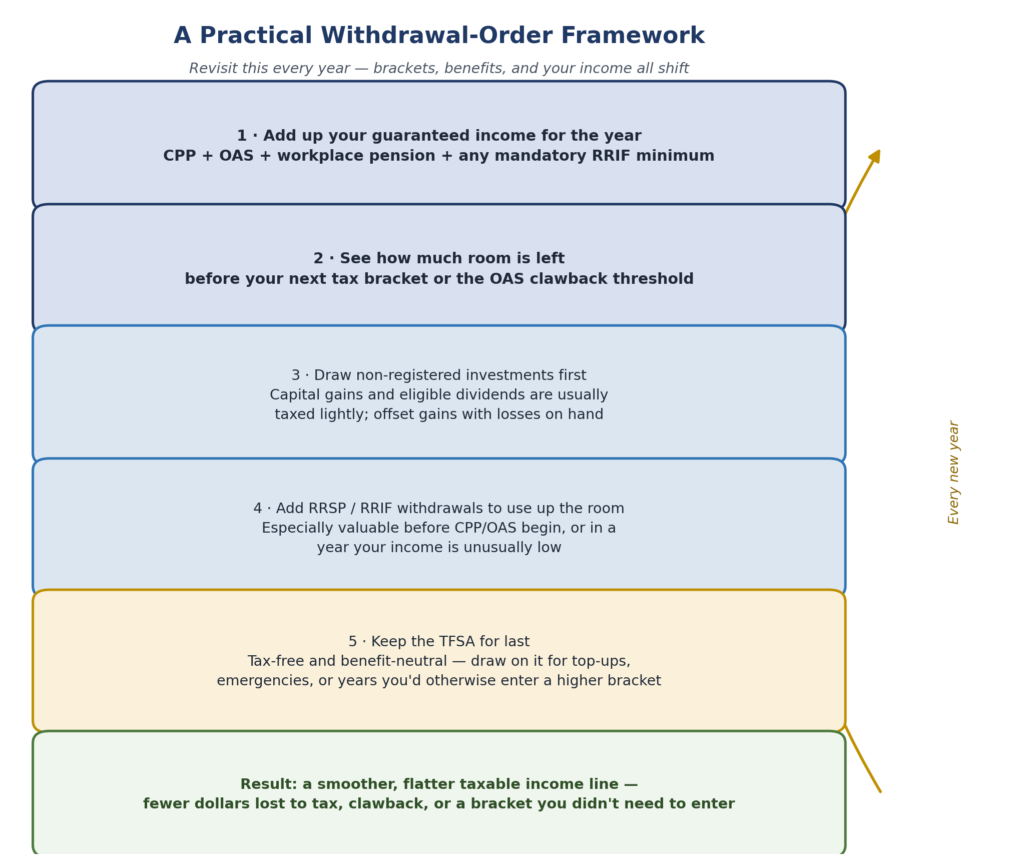
None of this requires predicting the future with precision. It requires an annual habit: before year-end, total up the income you can’t avoid CPP, OAS, any pension, any mandatory RRIF minimum and see how much room remains before the next bracket or the OAS threshold. That remaining room is what you get to allocate deliberately, and the account you choose to fill it from is the single highest-leverage decision in retirement tax planning.
5. Make the Most of Your TFSA
Of every account discussed in this guide, the TFSA behaves most differently from what its name might suggest to a first-time saver. It isn’t just a place to park savings inside retirement income planning specifically, it functions more like a release valve: a source of spendable cash that never shows up on the income side of your tax return.
That invisibility is the whole point. A TFSA withdrawal doesn’t add a single dollar to your net income, which means it can’t push you into a higher tax bracket, can’t trigger or worsen the OAS clawback, and perhaps most valuably for lower-income retirees can’t reduce your GIS entitlement by a single cent. Compare that to an equivalent RRIF withdrawal, which counts toward all three. A retiree deciding between pulling an extra $10,000 from a RRIF or a TFSA to cover a large one-off expense isn’t just choosing between two pots of money; if GIS or the OAS clawback is anywhere close to the picture, they may be choosing between keeping that $10,000 largely intact or losing a meaningful slice of it to tax and clawback combined.
The TFSA also makes an unusually good emergency fund in retirement, precisely because withdrawals can be made at any time, for any reason, without tax consequences or paperwork and any amount withdrawn is added back to your contribution room the following calendar year, so the space isn’t permanently lost. That flexibility is worth more in retirement than it was during your working years, since retirees are more likely to face lumpy, unpredictable expenses a new roof, a health-related cost, a family emergency without a paycheque to absorb the shock.
At death, the TFSA carries one more advantage: while an RRSP or RRIF is generally taxed as income in the deceased’s final return, a TFSA can pass to a surviving spouse as a “successor holder,” preserving its tax-free status entirely, or to any other beneficiary as a tax-free lump sum. For retirees thinking about what they’ll eventually leave behind, that makes the TFSA one of the more efficient assets to hold until the end, rather than one to draw down first.
None of this means the TFSA should always be the last account touched, but it does mean retirees should resist the instinct to treat it as an ordinary savings account rather than a planning tool. The best practice for most retirees is to keep it topped up during higher-income years, then draw on it deliberately: to fund a bracket-crossing expense, to protect a GIS or OAS entitlement in a particular year, or simply to have accessible, tax-free cash on hand without disturbing the rest of the plan.
To be continued……






Leave a comment