
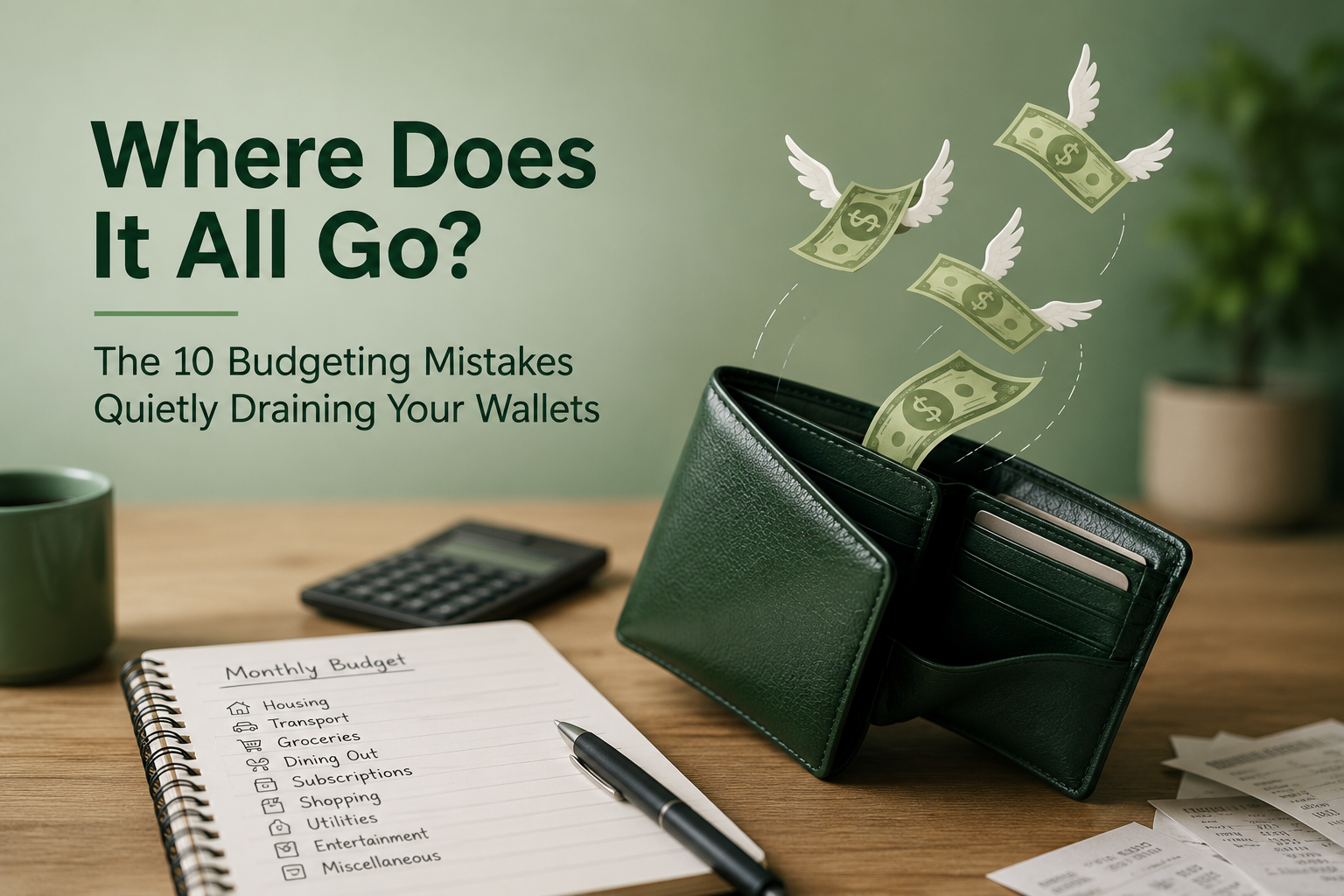

Between the grocery run that cost forty dollars more than you budgeted for and the mortgage renewal notice sitting on the counter, you’ve probably had the same thought more than once: I earn a decent living so why does there never seem to be enough left over?
You’re not imagining it, and it’s usually not one big financial disaster doing the damage. More often, it’s a handful of small, repeatable habits, the kind that never show up as one alarming charge on your statement, but quietly drain hundreds or thousands of dollars a year without you ever pinpointing exactly where.
The pressure behind that feeling is real. Grocery prices in Canada are still roughly 27 to 30 percent higher than they were five years ago, and Dalhousie University’s Canada’s Food Price Report 2026 puts the average family of four’s annual grocery bill at close to $17,600 this year, nearly $1,000 more than in 2025. Rent has cooled from its post-pandemic highs, but if you’re renting, you’re still paying well above what you would have five years ago. And household debt across the country has climbed for six consecutive quarters, with Canadians now owing roughly $1.80 for every dollar of disposable income they bring home.
Headline inflation itself has settled closer to the Bank of Canada’s target, sitting around 2.8 percent in mid-2026. But a cooling inflation rate doesn’t mean your bills are getting cheaper, it just means prices are climbing more slowly, on top of several years of increases that never reversed. That’s the gap between what your paycheque covered in 2019 and what it covers now, and it’s exactly where budgeting mistakes do the most damage.
This guide walks through the ten most common and most costly budgeting mistakes Canadian households make, why they happen, and exactly how to fix each one.
Why So Many Canadian Families Struggle With Budgeting

Before getting into the mistakes themselves, it helps to understand why budgeting feels genuinely harder right now, even if your income is stable and you’re not doing anything obviously wrong.
Inflation and the rising cost of living: Even as headline inflation eases, your core expenses haven’t gone back down; they’ve simply stopped climbing as fast. Food, shelter, and transportation eat up the majority of most Canadian households’ income, and all three still carry years of accumulated price growth that your pay-cheque has to work harder to cover.
High consumer debt: Statistics Canada’s most recent figures put household credit market debt at 179.6 percent of disposable income as of the first quarter of 2026 the sixth consecutive quarterly increase. In plain terms, the average Canadian household now carries $1.80 in debt for every dollar it takes home. If that sounds like you, you’re in the majority, not the exception.
The lingering effects of higher interest rates: The Bank of Canada has cut its benchmark rate considerably from its 2024 peak of 5 percent, holding it at 2.25 percent through much of 2026. But that relief hasn’t fully reached your budget: if you’re renewing a mortgage taken out during the ultra-low-rate years of 2020–2021, you’re likely facing a noticeably higher payment. And credit card rates have barely moved regardless of what the Bank of Canada does they’ve sat close to 20 percent for years.
Lifestyle inflation: As your income rises through a raise, a promotion, or a new job your spending tends to rise right along with it. A bigger apartment, a nicer car, a bit more takeout: each choice feels reasonable on its own, but together they can absorb every extra dollar before it ever reaches your savings account.
Lack of financial education: Nearly two-thirds of Canadians (64 percent) say they never received formal financial literacy education, according to a national survey commissioned by Edward Jones. If budgeting has always felt like a skill you’re supposed to already have, that’s exactly why most of us were never actually taught it.
Together, these five pressures explain why budgeting struggles are so widespread right now and why the mistakes below are less about carelessness and more about never having had a system built to handle any of this.
Mistake 1: Not Having a Budget at All
This is the most common mistake, and also the easiest to underestimate. If you’re like most Canadians, you manage money by instinct: pay the bills, keep an eye on your bank balance, adjust when things feel tight. It works, until it doesn’t.
Why this happens: Budgeting has a reputation for being restrictive, tedious, or only necessary for people who are “bad with money.” In reality, you probably avoid it for a much simpler reason: no one ever showed you a version of it that felt manageable.
The hidden cost: A recent TD Bank survey found that 67 percent of Canadians plan to cut back their spending in 2026, yet only 36 percent say they actually have a formal financial plan. That gap matters: good intentions without structure tend to produce a few weeks of frugality followed by a slide back into old patterns, rather than lasting change. Separately, financial advisers surveyed by Advocis reported that 60 percent of their clients either have no budget at all or struggle to absorb even a routine unexpected expense.
How to create a realistic monthly budget:
- Start with income versus expenses: List your actual take-home pay, then every expense: fixed costs like rent, insurance, and loan payments, and variable costs like groceries, gas, and entertainment. Don’t aim for a perfect first draft, just an honest starting point.
- Choose a method that fits your life: The 50/30/20 rule (50 percent needs, 30 percent wants, 20 percent savings and debt repayment) suits you if you want simplicity. Zero-based budgeting, where every dollar gets a job before the month starts, suits you if you want tighter control. The envelope method physical or digital works well if you know you overspend in one or two specific categories, like dining out.
- Set a review schedule, and actually keep it: A budget isn’t a document you write once and forget. A short weekly check-in, paired with a more thorough monthly review, stops small problems from quietly turning into big ones.
Mistake 2: Underestimating Everyday Spending
Big expenses get your attention because they’re big. The small, recurring ones slide by precisely because each individual purchase feels harmless.
The small expenses that add up:
- Coffee and quick food runs: A daily $6 coffee works out to roughly $180 a month over $2,000 a year before you’ve even factored in food.
- Food delivery: Delivery fees, service charges, and tips routinely add 30 to 40 percent on top of the menu price, turning a $15 meal into closer to $20.
- Subscription services: Streaming, music, gaming, and app subscriptions rarely get cancelled once the free trial ends. Statistics Canada data shows prices for video and audio subscription services have risen 21 percent since 2019, and Canadian households collectively spent $11.3 billion on streaming and cable services in 2024 alone.
- Impulse shopping: Online checkout has made impulse purchases nearly frictionless. One unplanned $50 buy feels insignificant; a dozen of them in a month is $600 you didn’t plan to spend.
Tips to track your spending accurately:
- Pull three months of bank and credit card statements and categorize every transaction the real total is almost always higher than you expect.
- Use a budgeting app such as YNAB or KOHO, or your bank’s built-in spending tracker, to catch recurring charges automatically.
- Run a subscription audit every few months and cancel anything you haven’t used in the past 30 days.
- Build in a small, guilt-free “fun money” allowance rather than trying to eliminate every discretionary purchase, a budget with zero room for enjoyment rarely survives contact with real life.
Mistake 3: Ignoring an Emergency Fund

An emergency fund isn’t a luxury reserved for people who already have their finances figured out. It’s what keeps a bad month from turning into a bad year.
Why emergencies derail budgets: Without a cash buffer, an unexpected expense doesn’t just cost you money, it forces a choice between high-interest debt and an unpaid bill. A recent RBC poll found that 76 percent of Canadians point to the high cost of living as the main barrier to building emergency savings, and 42 percent worry that a single major expense could derail their finances entirely.
Common examples:
- Car repairs are the single most-cited emergency expense, named by 39 percent of Canadians in RBC’s polling.
- Medical expenses not covered by your provincial health plan, like dental work, physiotherapy, or prescriptions.
- Home maintenance, from a failed furnace to a leaking roof.
- Job loss, especially with Canada’s unemployment rate holding near 6.5 percent through much of 2026.
The same RBC survey found that 32 percent of Canadians have no emergency fund at all, rising to 38 percent among households earning under $100,000 a year. If that’s you, you’ve got company: a separate United Way Centraide Canada poll found that 46 percent of Canadians could cover their basic expenses for only one month or less if they lost their income.
How much you should save
The standard guidance is three to six months of essential expenses: rent or mortgage, utilities, groceries, insurance, and minimum debt payments, not your full lifestyle spending. Aim for the higher end of that range if your income is variable, you’re the sole earner in your household, or you work in an industry prone to layoffs. You don’t need to build it all at once: automating $50 to $100 per paycheque into a separate high-interest savings account gets you real protection within 12 to 24 months.
Mistake 4: Depending Too Much on Credit Cards
Credit cards aren’t the problem. Carrying a balance on them is.
The real cost of high-interest debt
The average credit card interest rate in Canada runs between roughly 20 and 24 percent. Carry a $3,000 balance on a typical card near 20 percent and pay only the minimum each month, and you’re looking at more than 15 years to pay it off with total interest charges that end up higher than the $3,000 you originally borrowed.
Warning signs to watch for:
- You’re making only the minimum payment, month after month
- You’re using credit to cover essentials like groceries or gas because your paycheque runs out first
- You don’t know your total balance across all your cards without checking
- Your balance keeps creeping upward even though your spending “feels” about the same
Strategies to reduce credit card debt:
- The avalanche method pays minimums on every card, then puts all your extra money toward the highest-interest balance first. This saves you the most money over time.
- The snowball method pays off your smallest balance first for an early win, then rolls that payment into the next-smallest balance. This builds momentum if you need quick progress to stay motivated.
- Balance transfer cards Some Canadian cards offer promotional rates under 1 percent for the first several months, which can meaningfully speed up your payoff once you factor in the transfer fee.
- Pay more than the minimum, every time even an extra $50 a month noticeably cuts both your payoff timeline and the total interest you’ll pay.
Mistake 5: Not Planning for Annual or Seasonal Expenses
Some of the most disruptive costs you’ll face aren’t emergencies at all they’re predictable expenses that arrive once a year and catch you off guard anyway, simply because you never built them into your monthly budget.
Common examples:
- Holidays gifts, travel, and hosting costs that can easily total thousands of dollars
- Back-to-school supplies, often concentrated into a few weeks in late summer
- Property taxes, which many homeowners pay in one or two large instalments rather than monthly
- Vehicle insurance renewals, frequently billed as a single annual or semi-annual payment
- Home maintenance, like furnace servicing, eavestrough cleaning, or seasonal tire changes
Creating sinking funds
A sinking fund is simply a savings category for a specific future expense, built up in small amounts over time instead of all at once. If your holiday spending typically runs $1,200, setting aside $100 a month starting in January means the money is already there in December, no scrambling, no credit card balance carried into the new year. The same approach works for property taxes, insurance renewals, or any other cost that’s predictable in size but irregular in timing.
Mistake 6: Forgetting to Budget for Inflation
A budget you built two or three years ago and never updated is quietly out of date, even if nothing about your income or habits has changed.
Why yesterday’s budget no longer works
Grocery prices make the point clearly: food purchased from stores rose 4.3 percent year-over-year as of May 2026 faster than headline inflation and sits roughly 27 to 30 percent above where it was five years ago. If your grocery line has stayed the same since 2022, it simply doesn’t buy the same cart of food anymore, even though the number in your spreadsheet hasn’t moved.
Adjusting spending categories regularly
Rather than treating your budget categories as fixed, revisit them the way a business revisits its costs: expect most to drift upward gradually, and a few insurance subscriptions to jump sharply without warning.
Reviewing prices every few months
Every quarter, spot-check a handful of your regular purchases: a grocery staple, a fuel fill-up, a utility bill against what they cost six months earlier. If a category has crept up by 10 percent or more, either adjust your budget to reflect reality or go looking for ways to bring that specific cost back down.
Mistake 7: Overspending on Housing and Transportation
Housing and transportation together typically eat up the largest share of your budget, which means small percentage overspends here translate into the biggest dollar amounts anywhere in your finances.
Understanding the largest household expenses:
- Mortgage or rent: The average two-bedroom apartment in Canada carried an asking rent of roughly $2,150 a month in early 2026, according to Statistics Canada, ranging from about $1,900 in Montreal to over $3,100 in Vancouver. Even with rents cooling from their post-pandemic peak, you’re still paying well above pre-2020 levels in nearly every major city.
- Utilities: A typical household spends $300 to $450 a month on electricity, heating, water, and internet combined more if you’re in a colder province, where heating alone can account for 40 to 60 percent of your winter bill.
- Vehicle payments: The average monthly car payment in Canada runs roughly $700 to $915 for a new vehicle and around $600 for a used one.
- Fuel, which fluctuates with global oil prices and can shift your transportation budget significantly within a single season.
- Insurance, for both home and auto, which has risen noticeably for most Canadians over the past two years.
Ways to reduce these costs:
- Revisit whether your current home size and location still match your actual needs, downsizing or relocating even modestly can free up hundreds of dollars a month.
- Shop your mortgage renewal and insurance policies rather than letting them auto-renew; loyalty rarely earns you the best rate.
- Keep your total vehicle costs payment, insurance, gas, and maintenance combined under roughly 15 to 20 percent of your take home pay, a common benchmark among Canadian financial planners.
- Bundle your home and auto insurance, adjust deductibles where it makes sense, and re-shop coverage at every renewal instead of accepting the automatic increase.
- Where it’s realistic, use transit, carpooling, or a single household vehicle instead of two.
Mistake 8: Not Setting Financial Goals
A budget with no destination is just a list of restrictions. Financial goals turn it into an actual plan you’ll want to stick with.
Why goals make budgeting easier
It’s far easier to skip a night out when you can see the money going toward a house down payment than when it’s disappearing into a vague, unlabelled “savings” line. A goal gives every budgeting decision a reason.
Common examples:
- Buying a home, which in most Canadian cities now means years of dedicated saving for a down payment
- Retirement, where even modest contributions started early compound significantly over decades
- Education savings for your kids, often through a Registered Education Savings Plan (RESP)
- A vacation or major purchase, saved for deliberately rather than financed after the fact
- Paying off debt, whether student loans, a car loan, or credit card balances
Setting SMART financial goals
Effective goals are Specific, Measurable, Achievable, Relevant, and Time-bound. “Save more money” rarely works. “Save $6,000 for a home down payment by putting away $500 a month for 12 months” does because it’s specific enough to track, realistic enough to sustain, and has a clear finish line.
Mistake 9: Forgetting to Include Savings in the Budget

Most budgets treat savings as whatever happens to be left over at the end of the month. If that’s yours, savings probably happen rarely, if ever because there’s rarely anything left over.
Paying yourself first:
This means treating savings as a fixed, non-negotiable line item the same way you treat rent or a car payment rather than an afterthought. Common categories include:
- Emergency savings, until you hit your three-to-six-month target
- Retirement contributions, through an RRSP, a workplace pension, or both
- Children’s education, through an RESP, which comes with government grant matching that makes early, consistent contributions especially valuable
- Investment accounts, such as a TFSA, for goals beyond retirement
Automating savings:
The most reliable way to actually pay yourself first is to remove the decision entirely: set up an automatic transfer to a separate savings or investment account on payday, before the money has a chance to disappear into everyday spending. A modest automated amount, increased gradually over time, tends to beat larger but inconsistent manual transfers.
Mistake 10: Never Reviewing or Adjusting the Budget
A budget you build once and never revisit will eventually stop reflecting your reality, usually not because of one big change, but because life moves faster than an untouched spreadsheet.
Why budgets should evolve
The whole point of a budget is to match your spending to your actual circumstances. When those circumstances shift and your budget doesn’t, the gap between plan and reality quietly widens until the budget stops being useful at all.
Life changes that call for a budget update:
- A new job, which often changes your income, benefits, and commuting costs all at once
- A salary increase, which is a chance to boost your savings rather than let lifestyle inflation absorb it entirely
- A new baby, which reshapes nearly every category from housing to healthcare to childcare
- Moving, whether across the city or across the country, which shifts your rent, utilities, and transportation costs together
- Inflation itself, which as covered above quietly erodes a static budget even when nothing else about your life has changed
Monthly and quarterly reviews
A brief monthly check catches small overspends before they compound. A more thorough quarterly review is the right time to reassess whether entire categories housing, insurance, subscriptions still make sense, and to update your savings goals as your income or priorities shift. Only 36 percent of Canadians surveyed by TD heading into 2026 had a formal financial plan in place, a reminder that even the best intentions need a recurring review to turn into lasting results.
You Don’t Need More Willpower. You Need a System.

None of these ten mistakes are really about a lack of discipline. They’re about not having a system built around your real income, your real and rising costs, and the unpredictable expenses that show up regardless of what your spreadsheet says. Fix even two or three of them, and you’ll likely find real money that’s been quietly slipping through your fingers every month.
Building that system from scratch, while you’re juggling work, family, and the cost pressures covered here, is exactly where professional budgeting support earns its keep turning your good intentions into a plan that actually holds up, month after month.






Leave a comment