
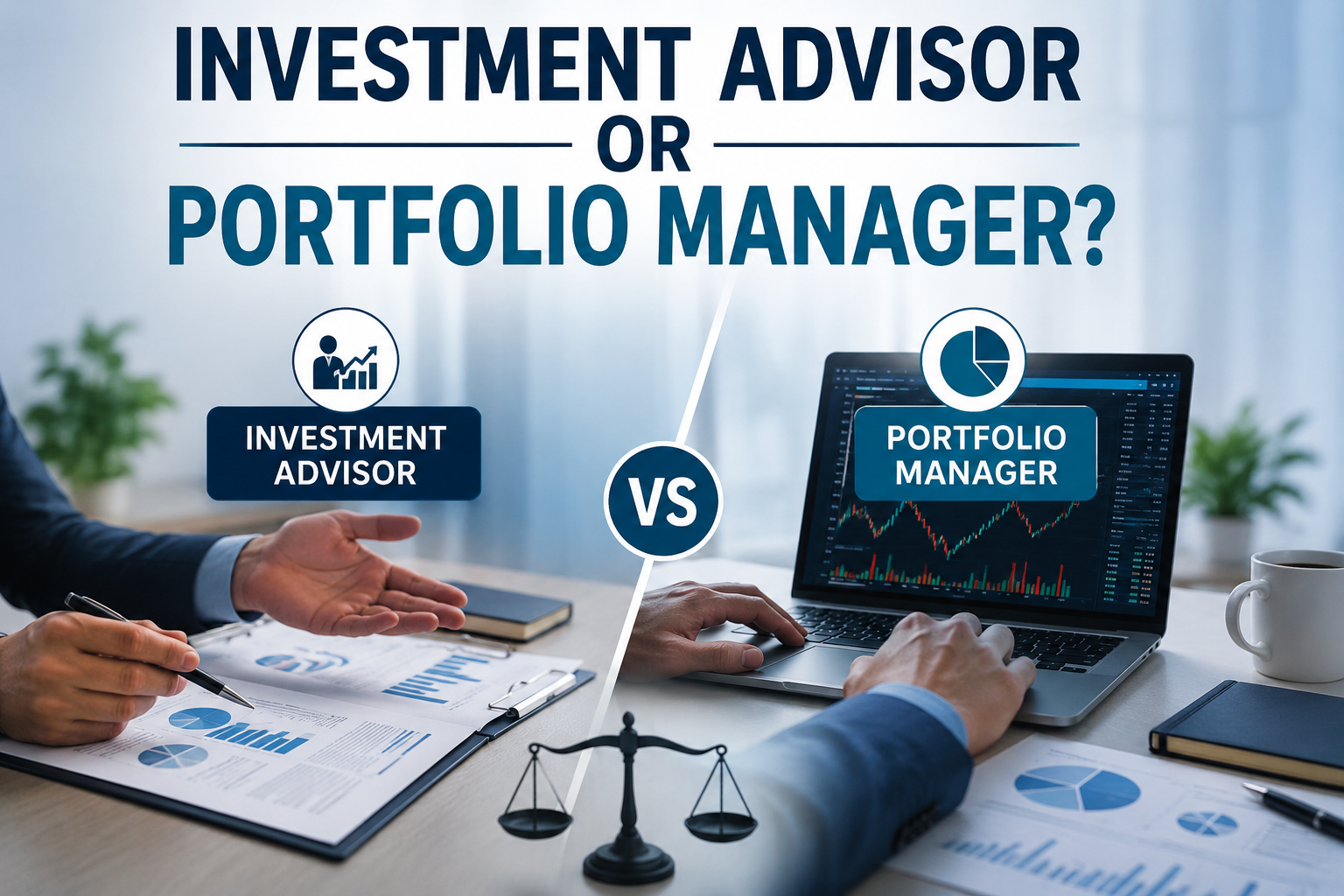

An investment advisor typically recommends investments and needs your sign-off before anything is bought or sold. A portfolio manager, by contrast, is registered specifically to make those buy-and-sell decisions on your behalf, often without asking first. That sounds like a procedural detail. In practice, it shapes everything from how quickly your account can respond to a market move, to what level of legal duty the person managing your money owes you, to how much you’ll typically pay and what kind of account minimum you’ll need to get in the door.
Two Distinct Roles in Investment Management

Before comparing the two side by side, it helps to understand each role on its own terms, starting with what each one is actually registered and licensed to do.
What Is an Investment Advisor?
An investment advisor sometimes called a financial advisor, or, more formally under Canadian securities rules, a dealing representative is a licensed professional who provides financial and investment advice and recommends suitable products, typically working for an investment dealer, mutual fund dealer, or bank-owned brokerage overseen by the Canadian Investment Regulatory Organization (CIRO). Their core role is relational and advisory: they get to know a client’s financial goals, help build an investment plan around those goals, and recommend specific products mutual funds, ETFs, individual stocks and bonds, GICs, and more suited to the client’s needs. Critically, in the traditional advisor relationship, recommending isn’t the same as deciding. The client generally has to approve each trade before it happens, which keeps the investor firmly in the driver’s seat even while leaning on the advisor’s expertise to choose the route.
What Is a Portfolio Manager?
A portfolio manager is a different kind of registrant altogether. Rather than recommending trades for a client to approve, a portfolio manager is licensed to manage an investment portfolio directly, making day-to-day buy, sell, and rebalancing decisions on the client’s behalf without needing sign-off for each one. In Canada, portfolio managers register directly with the securities commission in each province where they operate not through CIRO, the way investment dealers do and carry meaningfully higher proficiency requirements as a result of that authority, detailed in Section 6. Their focus is less about the advisory conversation and more about the portfolio itself: constructing it, managing risk within it, and working to maximize risk-adjusted returns over time, all under a discretionary mandate the client has authorized in advance.
Investment Advisor vs. Portfolio Manager: The Key Differences
The distinctions above become clearer laid out feature by feature. The table below summarizes how the two roles typically compare across the dimensions that matter most to an investor.
Investment Advisor vs. Portfolio Manager, At a Glance
| Feature | Investment Advisor | Portfolio Manager |
|---|---|---|
| Primary Role | Recommends investments and builds a financial plan around client goals | Manages a portfolio directly, making the investment decisions |
| Decision-Making Authority | Client approves each trade before execution | Manager decides and executes without prior approval (discretionary) |
| Investment Management | Product-focused selects funds and securities to recommend | Portfolio-focused constructs, rebalances, and actively manages the whole account |
| Client Interaction | Frequent, relationship-driven; regular check-ins and planning conversations | Less frequent day-to-day contact; periodic performance reviews and reporting |
| Fiduciary Responsibilities | Must put the client’s interest first on conflicts and suitability, though not always a full fiduciary as a matter of law | Owes an explicit fiduciary duty given the discretionary authority involved |
| Compensation Structure | Commissions, trailing commissions, or asset-based fees, depending on the firm and account | Almost always an asset-based (AUM) fee; occasionally a performance component |
| Level of Personalization | Personalized financial planning across a client’s broader financial life | Personalized to the portfolio’s construction and risk profile specifically |
| Typical Clients | New and mid-career investors; families with varied financial planning needs | High-net-worth individuals, busy professionals, and institutional investors |
One more nuance worth flagging: the two roles aren’t always mutually exclusive. Many Canadian wealth management practices, particularly at bank-owned private investment counsel divisions, are staffed by individuals who hold both a dealing representative registration and a portfolio manager registration, or by teams that combine both functions under one roof, delivering the relationship-driven planning of an advisor alongside the discretionary authority of a portfolio manager. Where that combination exists, the comparison above describes two capabilities the same team may offer, rather than two entirely separate paths to choose between.
What Does an Investment Advisor Actually Do?
An investment advisor’s day-to-day work is built around a single relationship at a time, repeated across a book of clients that might range from a few dozen to a few hundred. It starts with genuinely understanding a client’s financial goals, not just “grow my money,” but the specific milestones behind that: a home purchase, a child’s education, a target retirement date, a business sale down the road. From there, the advisor assesses risk tolerance, usually through a structured questionnaire required under know-your-client rules, but ideally through real conversation about how a client would actually react to a serious market downturn, not just how they assume they’d react on paper.
With goals and risk tolerance established, the advisor develops an investment strategy and recommends the specific vehicles to implement it mutual funds, ETFs, individual stocks and bonds, GICs, and increasingly model portfolios built from low-cost index funds. But a good investment advisor’s value rarely stops at product selection. Retirement planning is a constant thread running through the relationship: projecting whether current savings and contribution rates will actually support the retirement a client has in mind, and adjusting course well before it’s too late to matter. Tax-efficient investing shapes which accounts hold which investments, weighing the trade-offs between an RRSP, a TFSA, and a non-registered account for any given dollar. Education savings planning, particularly RESP contributions and the government grants attached to them, is a routine part of the conversation for clients with children, and it’s an area where a few overlooked details, like unused grant room, can genuinely cost a family money if nobody’s watching for it.
Consider a dual-income couple in their late thirties with two young children: an advisor in this scenario isn’t just picking funds. They’re modelling whether current RRSP and TFSA contributions realistically support both a comfortable retirement and two RESP accounts, flagging that unused Canada Education Savings Grant room from a slower contribution year is still recoverable, and coordinating with the couple’s accountant when one of them starts freelancing on the side. That coordination extends to estate planning too: advisors frequently work alongside a client’s lawyer or accountant to make sure beneficiary designations, account structures, and the investment plan itself all point in the same direction, rather than quietly working against each other.
None of this is a one-time exercise. Regular portfolio reviews and adjustments, typically at least annually, keep the plan aligned as a client’s life, goals, and the markets themselves change. It’s this ongoing, holistic relationship, as much coach and planner as investment picker, that defines the investment advisor’s role, and it’s a big part of why the relationship tends to matter as much as any single recommendation.
What Does a Portfolio Manager Actually Do?

Where an investment advisor’s work centers on the client relationship, a portfolio manager’s work centers on the portfolio itself: the actual construction, execution, and ongoing management of a basket of investments built to meet a defined mandate.
That starts with construction: translating a client’s goals, time horizon, and risk tolerance, usually documented in a formal Investment Policy Statement, into an actual asset allocation and security selection. Getting there requires real analytical groundwork: market research and economic analysis to form a view on where opportunity and risk currently sit, followed by security selection picking the specific stocks, bonds, ETFs, or other instruments that will fill out the portfolio’s asset classes and sectors. Once the portfolio exists, the portfolio manager is the one actually buying and selling, executing trades directly under the discretionary authority the client has granted, rather than proposing them and waiting for a green light.
The job doesn’t end at construction. Portfolios are monitored continuously against their benchmarks and mandates, and rebalanced periodically to bring an allocation that’s drifted, say, after a strong run in equities, back to its intended target. Risk management runs throughout: position sizing, diversification across sectors and geographies, and hedging where appropriate, all aimed at keeping the portfolio’s risk profile consistent with what the client signed up for, not just chasing the highest possible return. And because markets don’t hold still, portfolio managers adapt their strategy as conditions change: trimming exposure ahead of anticipated volatility, rotating into sectors with a more favourable outlook, or simply holding steady when the data doesn’t yet justify a change, which is very often the harder discipline of the two.
Portfolio managers also tend to operate with a wider toolkit than most advisor-recommended accounts allow access to institutional pricing, pooled funds unavailable to retail investors, and sometimes alternative asset classes like private debt or real assets, all of which can meaningfully change what a portfolio is able to do relative to a standard retail lineup of mutual funds and ETFs. The throughline across all of it is a mandate to optimize returns over the long term relative to the risk the client has agreed to take on, not to chase short-term performance, and not to wait for permission to act when the strategy calls for a change.
Discretionary vs. Non-Discretionary Portfolio Management
The single biggest functional difference between an investment advisor and a portfolio manager comes down to one word: discretion. Understanding what that word actually means in practice clarifies almost everything else in this guide.
Discretionary Portfolio Management
In a discretionary arrangement, the manager makes investment decisions and executes trades without needing prior approval for each one, operating instead within boundaries set out in advance: the client’s Investment Policy Statement, risk tolerance, and any specific restrictions the client has flagged, such as excluding a particular sector or avoiding certain industries entirely. This authority is exactly what defines the Portfolio Manager registration category under Canadian securities law, and it comes with a correspondingly higher proficiency bar and an explicit fiduciary duty, both discussed further in Section 6.
The practical benefit is speed. A discretionary manager can respond to a market opportunity, or a market threat, the moment it appears, rather than waiting to reach a client, explain the rationale, and get a yes. For a busy investor, someone traveling frequently, running a business, or simply uninterested in fielding calls about every trade, that responsiveness, paired with not having to make or approve each individual decision, is often the entire appeal of working with a portfolio manager in the first place.
Non-Discretionary Portfolio Management
Non-discretionary management flips the sequence: the advisor or manager identifies an opportunity and brings a specific recommendation to the client, and nothing gets bought or sold until the client says yes. This is the default arrangement for most investment advisor relationships, and it’s also available, in some cases, through portfolio managers working with clients who want professional input without fully relinquishing control.
The trade-off is the mirror image of the discretionary model: slower to execute, since every trade depends on reaching the client and getting a decision, but with the investor retaining full, active involvement in every choice made in the account. For investors who want to understand and personally sign off on the reasoning behind every trade, whether out of caution, a desire to keep learning, or simply a preference for control, non-discretionary management keeps that door open in a way discretionary management, by design, does not.
Licensing, Qualifications, and Professional Credentials
Both roles require formal registration in Canada, but the bar sits at noticeably different heights. An investment advisor working at an investment dealer or mutual fund dealer registers as a dealing representative, overseen by the Canadian Investment Regulatory Organization (CIRO), the national self-regulatory body formed from the 2023 merger of the former IIROC and MFDA. Getting registered typically means completing the Canadian Securities Course and a Conduct and Practices Handbook exam, along with firm-specific training, followed by a period working under the supervision of a branch manager.
A portfolio manager faces a meaningfully steeper path, and, notably, doesn’t register through CIRO at all. Portfolio managers register directly with the securities commission in whichever provinces they operate (Ontario’s OSC, British Columbia’s BCSC, and so on, coordinated nationally through the Canadian Securities Administrators), under rules set out in National Instrument 31-103. To act independently as an advising representative, the individual category that carries full portfolio manager authority, a person generally needs either a CFA Charter plus 12 months of relevant investment management experience in the prior three years, or the CIM designation plus 48 months of relevant experience. A more junior associate advising representative role, which can meet with clients and make recommendations but must work under a fully licensed advising representative’s supervision, has a lighter bar: CFA Level 1 plus 24 months of experience, or the CIM designation plus 24 months. Both individual categories, along with the firm’s chief compliance officer, also carry ongoing continuing education requirements to keep the registration current.
Common Professional Designations
CFA (Chartered Financial Analyst)
The CFA Charter, administered globally by the CFA Institute, is widely considered the gold standard for investment analysis and portfolio management expertise. Earning it means passing three progressively difficult exam levels, each requiring roughly 300 hours of study, alongside accumulating 4,000 hours of qualified investment-related work experience over a minimum of three years. Most candidates take around four years from start to finish. In Canada, the CFA Charter is also the fastest route to full portfolio manager registration, as the requirements above show.
CFP (Certified Financial Planner)
The CFP designation, granted in Canada by FP Canada, is the most widely recognized credential for comprehensive financial planning rather than pure investment management. Earning it requires completing an approved education program, passing a national exam, demonstrating three years of qualifying work experience, and committing to FP Canada’s Standards of Professional Responsibility. CFP professionals are generally held to a fiduciary standard in their financial planning work, which makes the designation a strong signal for anyone whose needs extend beyond investments into the fuller picture of retirement, tax, and estate planning discussed in Section 3.
CIM (Chartered Investment Manager)
The CIM designation, historically known as the Canadian Investment Manager designation and still often referred to that way, is administered by the Canadian Securities Institute and is, by design, the credential most directly tied to discretionary portfolio management in Canada. It requires completing one of two approved education paths plus two years of relevant investment management experience gained within the prior five years. As the NI 31-103 requirements above show, it’s one of two recognized routes, alongside the CFA Charter, to registering as a portfolio manager in Canada, which makes it a credential seen disproportionately often among portfolio managers rather than investment advisors.
CPA (Chartered Professional Accountant)

The CPA designation isn’t an investment credential at all, but it shows up often enough among both advisors and portfolio managers to be worth noting. A CPA brings genuine depth in tax and accounting, valuable for tax-efficient investing, business owner and incorporation questions, and estate and succession planning, and some advisors and portfolio managers hold it alongside a CFA or CFP to round out their expertise, particularly when working with self-employed or business-owner clients.
Credentials aren’t just letters after a name. Under Canadian securities regulation, they’re often the literal mechanism by which someone becomes eligible to hold discretionary authority over your money in the first place, which is exactly why it’s worth asking, plainly, what registration category and credentials the person you’re working with actually holds, rather than assuming the job title tells the whole story.
How They Get Paid
Compensation structure shapes incentives, and incentives, however subtly, can shape recommendations. It’s worth understanding how each professional is actually paid before assuming their advice is untouched by it.
Investment Advisors
Investment advisors in Canada are compensated through several possible models, and increasingly through a blend of them. Commission-based compensation, once the dominant model, has been sharply curtailed: deferred sales charges, the structure that paid an advisor’s firm an upfront commission while locking a client into redemption fees for years afterward, were banned across Canada effective June 2022. What remains legal, and common, is the ongoing trailing commission embedded in many mutual funds’ fees, paid to the dealer for as long as a client holds the fund, provided the dealer continues providing advice and a suitability determination. Asset-based fee accounts, where the client pays a transparent annual percentage of assets instead of relying solely on embedded fund costs, have grown significantly as a share of the industry, partly in response to regulatory pressure for clearer, more comparable fee disclosure. True fee-only advisors, paid a flat or hourly fee with no product-linked compensation at all, remain relatively rare in Canada outside independent financial planning practices, though the model is growing. Many advisors today land somewhere in between: a hybrid structure blending an asset-based fee on managed accounts with product-linked compensation on anything held outside that arrangement.
Portfolio Managers
Portfolio managers are compensated more uniformly, and more simply: an assets-under-management fee, charged as a percentage of the portfolio’s value and typically billed quarterly. Rates vary with account size and strategy but commonly fall somewhere in the 0.8% to 1.2% range for discretionary retail accounts, often on a tiered schedule that lowers the percentage as assets grow. To make the difference concrete: on a $500,000 portfolio, a 1% AUM fee runs about $5,000 a year, itemized clearly on every statement. A comparable dollar amount embedded as a trailing commission inside a fund’s management expense ratio can be similar in size, but it’s baked into the fund’s returns rather than billed separately, which is precisely why regulators pushed for the clearer, side-by-side cost disclosure that came with CRM2 and the Client Focused Reforms. Because an AUM fee is itemized directly, and because it’s often deductible as a carrying charge against non-registered investment income under Canadian tax rules, it tends to be viewed as one of the more transparent compensation structures available. Performance-based fees exist too, though they’re used far more often in institutional mandates and pooled or alternative strategies than in standard retail accounts, where regulatory conditions around benchmarks and high-water marks make them less common. Institutional portfolio managers, running money for pension funds, endowments, or mutual funds themselves, are typically paid a management fee negotiated directly with the institution, sometimes layered with a performance component tied to a specific benchmark.
The incentive difference is worth sitting with for a moment. A compensation model tied to product sales creates at least the possibility that a recommendation reflects what pays the advisor as much as what serves the client, which is precisely the dynamic the Client Focused Reforms were designed to police, without eliminating commission-based compensation outright. An AUM fee model, by contrast, aligns the manager’s income with the portfolio’s growth: the manager generally earns more only if the client’s account does too, though it’s worth remembering that an AUM fee is charged whether or not the portfolio actually outperforms, and it compounds against total assets even in a flat or losing year. Neither model is inherently better in every case, but understanding which one applies to your own advisor or manager is one of the simplest ways to understand what’s actually shaping the advice you receive.
Advantages of Working with an Investment Advisor
The case for an investment advisor rests less on investment performance specifically and more on the breadth and continuity of the relationship. Holistic financial planning is the clearest advantage: an advisor typically looks at the whole financial picture, savings rate, debt, insurance, tax situation, retirement timeline, rather than just the portfolio in isolation, which matters enormously for anyone whose investment decisions can’t sensibly be separated from the rest of their finances. That translates into genuinely personalized guidance, shaped around a specific client’s goals and life stage rather than a standardized mandate.
Retirement and tax planning support tends to be woven into the relationship rather than billed as a separate service, and for many households, an advisor is the only professional actively tracking whether their RRSP, TFSA, and non-registered accounts are working together instead of against each other. Perhaps the most underrated advantage, though, is behavioral: a good advisor acts as a steadying presence during market volatility, talking a nervous client through a downturn rather than letting panic drive a decision to sell at exactly the wrong moment, a service that’s easy to dismiss in a calm market and hard to overstate in a bad one.
And because the relationship is built to last years, not quarters, it carries a level of accountability and continuity that’s difficult to replicate: the same advisor who set the plan is generally the one revisiting it, adjusting it, and answering for it as circumstances change. That accountability shows up in small ways that add up: a call ahead of a large purchase to check the tax implications, a nudge to update a beneficiary designation after a life change, a second opinion before a major decision that has nothing to do with the stock market at all. It’s this combination, plan, guidance, and an actual person keeping an eye on the whole picture over time, that makes the investment advisor relationship valuable well beyond any single trade or recommendation.
Advantages of Hiring a Portfolio Manager
The case for a portfolio manager is built around professional, active management of the investment portfolio itself, delivered with a level of attention most investors can’t replicate on their own. Active portfolio monitoring means the account is being watched continuously, not just at scheduled review meetings, and access to institutional-level research, the kind of market and company analysis typically unavailable to retail investors, informs decisions in a way that a single advisor juggling a large client book usually can’t match.
Strategic asset allocation is handled as an ongoing discipline rather than a one-time decision made at account opening, with genuine risk management expertise behind decisions about diversification, position sizing, and when to reduce exposure ahead of anticipated volatility. For investors with significant assets or complex financial lives, the time savings alone can be substantial: no need to review individual trade recommendations, approve each transaction, or track the portfolio’s positioning relative to markets that never stop moving. And because a portfolio manager doesn’t need to reach the client before acting, they can respond to changing market conditions, an emerging risk, a sudden opportunity, the moment it appears, rather than after the delay a non-discretionary relationship necessarily introduces.
Consider a business owner in her late fifties who has just sold her company and is sitting on several million dollars in investable proceeds for the first time in her life. Rather than researching individual securities or approving trades one at a time on a portfolio this size, she engages a portfolio manager who builds a diversified mandate around her new reality: more capital than she’s ever managed, a shorter runway to retirement, and a portfolio that suddenly carries estate and tax considerations it never had before. From there, the manager runs it actively, checking in with her quarterly rather than for every individual decision along the way.
For an investor who has built meaningful wealth, that combination of expertise, attentiveness, and speed is often worth more than the fee it costs, not because a portfolio manager can guarantee better returns than a self-directed or advisor-guided approach (no one can promise that), but because professional management removes both the burden of the decisions and the emotional weight of making them alone.
When an Investment Advisor Is the Better Choice

An investment advisor tends to be the better fit earlier in an investor’s financial life, or whenever the need extends well beyond the portfolio itself. New investors, who benefit as much from education and structure as from any specific product recommendation, generally get more value from an advisor’s guidance than from a discretionary account they don’t yet have the context to evaluate. The same is true for individuals seeking comprehensive financial planning: anyone whose picture includes debt, insurance, a business, or a tax situation that a narrow investment mandate wouldn’t touch.
Families planning around specific milestones, a home purchase, a child’s education, retirement itself, tend to do well with an advisor precisely because those goals require coordinating across the full financial picture, not just optimizing a portfolio. Investors who want guidance before making decisions, rather than a professional making decisions for them, are simply better matched to the non-discretionary model an advisor typically operates under. And for anyone who prefers a collaborative approach to financial planning, someone who wants to understand the reasoning, ask questions, and stay actively involved, an investment advisor relationship is built for exactly that kind of engagement in a way a discretionary portfolio manager relationship generally isn’t.
When a Portfolio Manager May Be the Better Choice
A portfolio manager tends to make more sense once an investor’s assets, complexity, or available time cross a certain threshold. High-net-worth individuals, who typically need to meet the $500,000-and-up minimums common among Canadian portfolio management firms, often get real value from the sophistication and attention a discretionary mandate provides, value that’s harder to access at smaller account sizes. Busy professionals, who may simply not have the bandwidth to review and approve investment decisions on an ongoing basis, tend to value the delegation as much as the expertise itself.
Experienced investors seeking professional management, people who understand markets well enough to evaluate a manager’s approach but would rather not execute it personally, are a natural fit, as are investors with genuinely complex portfolios: multiple account types, concentrated positions, cross-border considerations, or estate and trust structures that benefit from coordinated, professional oversight. And for anyone who has thought it through and genuinely prefers discretionary management, trusting a qualified professional to act without checking in first, in exchange for faster execution and one less decision to carry, a portfolio manager relationship is built specifically around that preference.
There’s no universally correct answer between the two, and plenty of investors move from one into the other as their circumstances change: a new investor who becomes an advisor’s long-time client for a decade, then eventually crosses into portfolio manager territory once their assets and needs have grown to match. What matters most isn’t picking the “better” title, but understanding, clearly, what the person managing your money is actually licensed to do, how they’re compensated for doing it, and whether that arrangement matches how involved you actually want to be.





Leave a comment