
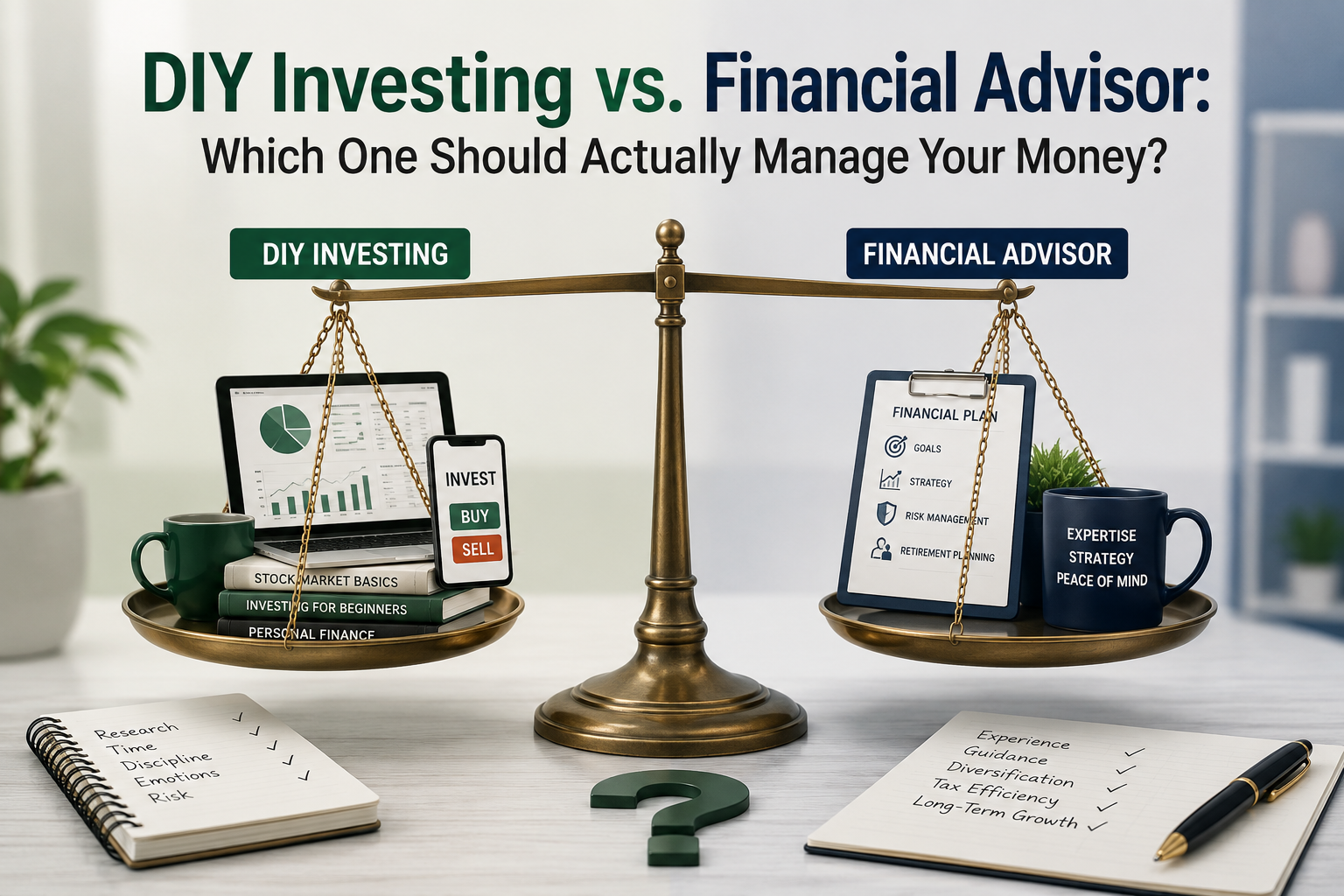

At some point, every investor in Canada runs into the same decision. Maybe it’s when a TFSA sits half-funded because opening a brokerage account feels like homework. Maybe it’s after a coworker mentions their advisor “handles everything” and you start wondering if you’re leaving money on the table by not having one. Either way, the underlying question doesn’t change: should you manage your own investments, or pay someone else to do it?
This isn’t a new debate, but the ground underneath it has shifted. Zero-commission trading, robo-advisors, and an endless stream of financial content online have made the DIY route far more approachable than it was a decade ago. At the same time, research keeps surfacing evidence that a good advisor earns their fee many times over just not always in ways that show up on a monthly statement. Neither side of this is wrong. What matters is which one actually fits your money, your time, and how you behave when markets get uncomfortable.
Let’s look at both paths honestly, backed by the numbers, so you can make the call with your eyes open.
What DIY Investing Really Means

DIY investing means exactly what it sounds like: you research, choose, buy, sell, and monitor your own investments, without a licensed advisor making those calls for you or walking you through them. You decide the account type, the asset mix, when to rebalance, and when, if ever to sell.
It’s also, by the numbers, no longer a niche choice. Canada’s securities regulators found that 45% of investors now hold at least one self-directed account, and roughly a third of those accounts were opened in just the past two years. One investor advocacy group tracked an even more dramatic shift, with the number of self-directed accounts in Canada jumping from about 2.3 million to 11.4 million between 2020 and 2023. Other surveys put self-identified DIY investors at closer to one in three Canadians overall, rising to nearly 37% among Millennials specifically. Over the same stretch, the share of investors who say they work with a financial advisor has been sliding down to roughly six in ten in the most recent national data, with the steepest drop-off among investors under 45 and those with smaller portfolios.
When investors are actually asked why they went the DIY route, the answers cluster around a few honest themes: a large share simply enjoy managing their own money, a similar-sized group say an advisor’s fees didn’t make sense for their account size, and a smaller group figure they don’t have enough saved to interest a traditional advisor in the first place.
Where DIY Investors Actually Put Their Money
Self-directed brokerage accounts are the backbone of DIY investing in Canada platforms like Questrade, Wealthsimple Trade, and the direct-investing arms of the big banks, where you place your own trades and choose your own holdings. Within those accounts, most DIY portfolios are built from some mix of exchange-traded funds (ETFs), individual stocks, and mutual funds, each with a different cost and complexity profile. ETFs in particular have become the default building block for cost-conscious DIY investors, since a single low-fee fund can hold thousands of underlying stocks or bonds at once.
Robo-advisors occupy a middle ground worth understanding on their own terms. Services like Questwealth (Questrade’s managed portfolios) and Wealthsimple Invest still count as a form of self-directed investing, in the sense that there’s no human advisor sitting across from you but an algorithm, overseen by a professional portfolio team, builds, monitors, and rebalances your portfolio automatically. The pricing gap between the two is real: Questwealth’s management fee runs about a quarter of one percent for most account sizes, while Wealthsimple’s starts closer to half a percent and steps down as your balance crosses $100,000 and again past $500,000. Add in the underlying ETF costs, and most robo-advisor clients land somewhere around 0.5% to 0.75% all-in a fraction of what a traditional advisory relationship typically costs, though with far less personal guidance attached.
What a Financial Advisor Actually Does for You

A financial advisor’s job, at its core, is to help you build a plan for your money and then keep you on it adjusting the strategy as your income, goals, and life circumstances change, rather than simply picking a few investments and walking away. For Canadians with more going on financially than a single TFSA and a savings goal, that ongoing relationship tends to matter more than any one piece of investment advice.
The Full Menu of Services
“Financial advisor” can describe a fairly narrow relationship focused on picking investments, or something closer to a personal CFO. On the broader end of that spectrum, services typically include full financial planning mapping out how your income, debt, and goals fit together retirement planning, which means figuring out how much you’ll actually need and how to draw it down tax-efficiently once you get there, and day-to-day investment management. Many advisors also handle tax-efficient investing, deciding what belongs in an RRSP versus a TFSA versus a non-registered account, alongside estate planning, insurance planning, and education savings strategies for parents building an RESP.
Behind the scenes, a good advisor is also regularly rebalancing your portfolio back to its target allocation and reassessing how much risk you can actually stomach of tasks that sound simple but are among the more commonly skipped jobs for people managing their own money.
Not All “Financial Advisors” Are the Same
Here’s the part that trips up a lot of Canadians: “financial advisor” isn’t a protected, legally defined title in this country. Almost anyone can put it on a business card. What actually matters is how the person is registered and how they’re paid, both of which fall under the oversight of the Canadian Investment Regulatory Organization (CIRO), the national self-regulatory body for investment dealers and mutual fund dealers.
Fee-only advisors, sometimes called advice-only, are paid directly by you by the hour, a flat rate for a plan, or occasionally a percentage of assets and collect no commissions from the products they recommend. This model is still relatively rare in Canada, but it’s the cleanest from a conflict-of-interest standpoint, and it’s often paired with the CFP (Certified Financial Planner) designation.
Fee-based advisors charge an ongoing percentage of the assets they manage for you, typically landing somewhere between roughly 0.75% and 1.5% a year depending on portfolio size and the scope of the relationship. Within this model, a “managed” account means a portfolio manager can trade on your behalf without asking first; a “non-managed” account still requires your sign-off on each transaction.
Commission-based advisors earn money when you buy or sell certain products, most commonly through trailing commissions embedded in a mutual fund’s ongoing fee and largely invisible on your account statement. This is the model with the most potential for conflicted advice, since an advisor’s income can end up tied to which products you hold rather than purely to how your portfolio performs.
Beyond compensation structure, two more titles come up often in Canada: portfolio managers, a specific registration category that comes with discretionary trading authority and typically serves larger accounts, and wealth managers, a broader and less formally defined title for advisors who bundle investment management with tax, estate, and insurance planning for clients with more complex financial lives.
DIY vs. Advisor: How They Really Stack Up
Strip away the marketing on both sides, and the trade-off comes down to a short list of things: cost, time, control, and discipline.
On cost, DIY usually wins in the most literal sense a self-directed ETF portfolio can run well under 0.5% a year in total fees, compared with a typical advisory relationship in the 0.75% to 1.5% range, or considerably more for commission-based mutual funds, whose fees in Canada are among the highest in the developed world and routinely exceed 2%. On decision-making, DIY investing puts every call in your hands, for better or worse, while an advisor brings a professional perspective and, crucially, someone to talk you off the ledge during a downturn.
Time required tracks a similar split: DIY investing demands real, ongoing hours spent researching and monitoring, while an advisor absorbs most of that workload on your behalf. The knowledge required to do it well is also genuinely higher on the DIY side, since you’re responsible for understanding asset allocation, tax rules, and risk without a professional double-checking your logic, whereas an advisor relationship assumes a more moderate baseline of financial literacy from the client.
Emotional discipline follows the same pattern. As a DIY investor, staying calm during volatility is entirely on you; a decent advisor’s most underrated function is providing exactly that discipline from the outside. Portfolio monitoring and tax planning are, by default, your personal responsibility when you go it alone, whereas they’re built into what you’re paying for with an advisor and the same goes for retirement planning, where DIY investors self-manage every projection and drawdown decision, while advisors typically fold that into ongoing, comprehensive planning. On personalization, it genuinely depends on the investor: a disciplined DIY investor can build something highly tailored to their own goals, while a good advisor offers personalization almost by definition, since that’s the service being paid for.
None of this makes one column objectively “better.” It means the two paths ask different things of you, and give back different things in return.
The Honest Case for Investing on Your Own

The financial case for DIY investing is straightforward and easy to demonstrate with a calculator: fees compound. A self-directed investor holding low-cost ETFs might pay somewhere in the neighbourhood of 0.2% to 0.5% a year in total costs. A comparable advised portfolio sitting in commission-based mutual funds can easily run $7,500 to $12,500 a year in combined fees and trailing commissions on a $500,000 portfolio, versus roughly $2,500 to $7,500 for a fee-only advisor using ETFs. Over a decade, that gap compounds into anywhere from about $17,500 to more than $60,000 in savings money that stays invested and growing instead of leaving your account every year regardless of performance.
Beyond cost, DIY investors keep full control over every decision what to buy, when to sell, how aggressively to position a portfolio without needing to run it past anyone else first. That flexibility appeals particularly to investors who want to hold something an advisor might not offer, whether that’s a specific ETF, an individual stock they’ve researched themselves, or an asset class outside a standard model portfolio. There’s also a genuine educational upside that’s easy to undersell: managing your own money forces you to actually understand tax rules, asset allocation, and risk in a way that handing it off to someone else doesn’t.
The honest downsides are just as real. DIY investing assumes a level of financial knowledge that most people don’t start out with, and building it takes real time and, often, some expensive mistakes along the way. The emotional side is arguably the bigger risk: research on investor behaviour consistently finds that individual investors underperform the very funds they invest in, largely because of poorly timed buying and selling driven by fear and euphoria rather than strategy. One widely cited annual study found the average equity fund investor trailed the S&P 500 by roughly 8.5 percentage points in a single recent year, and by more than a full percentage point annually over 20 years, a gap driven almost entirely by behaviour, not by the investments themselves. (Some analysts argue this kind of study overstates the true size of the gap, given how it’s calculated, but the underlying pattern that emotional, mistimed decisions cost real money shows up in nearly every version of this research.) On top of the knowledge and emotional demands, DIY investing is genuinely time-intensive, and requires ongoing education just to keep up as tax rules, products, and markets change.
The Honest Case for Hiring a Financial Advisor
The case for paying someone else starts with something that’s easy to dismiss until you’ve lived through a market downturn: behavioural coaching. A 2024 study by Russell Investments estimated that Canadian advisors add roughly 3.5% in annual value through a combination of active rebalancing, customized planning, and tax-smart strategies with behavioural coaching alone, simply keeping clients from making costly emotional decisions during volatile markets, making up the single largest slice of that value.
Separately, research from the Montreal-based CIRANO Institute, tracking real Canadian households over more than a decade, found that investors with an ongoing advisor relationship had accumulated close to four times the assets of comparable non-advised households after 15 years, even after controlling for income, education, and dozens of other factors. A related industry study estimated that Canadians who start saving with an advisor in their mid-20s could retire with over 50% more savings than a comparable DIY saver, largely through better savings discipline rather than superior stock-picking.
It’s worth being upfront that some of this research comes from organizations with a stake in the advice industry, which doesn’t make the findings wrong, but does mean they’re worth reading as directionally useful rather than gospel. What holds up across independent behavioural research too is the core mechanism: advisors tend to add value less through beating the market and more through preventing their clients from sabotaging themselves.
Beyond behaviour, advisors bring genuine technical expertise to situations that get complicated fast: structuring withdrawals in retirement to minimize tax, coordinating a business owner’s corporate and personal accounts, or building an estate plan that actually holds up. That expertise comes personalized to your specific numbers, wrapped into ongoing portfolio monitoring you don’t have to remember to do yourself.
The trade-offs are equally real. Advisory fees are an ongoing cost regardless of how markets perform, and depending on the fee model, they can be considerably higher than a DIY approach. Handing over decisions also means giving up a measure of direct control, and because “financial advisor” isn’t a regulated title in Canada, advisor quality varies enormously from excellent fee-only planners to advisors whose compensation model quietly rewards recommending certain products over others. That last point is really the crux of it: a commission-based advisor’s incentives aren’t automatically aligned with yours, and it’s on you to ask directly how they’re paid before committing to work with them.
Who Should Seriously Consider DIY Investing
DIY investing tends to suit a fairly specific kind of Canadian: someone who actually enjoys reading about markets rather than merely tolerating it, who has the time to research and monitor a portfolio on an ongoing basis, and who can watch a portfolio drop 20% without making a panicked decision. It also fits best when your financial situation is relatively uncomplicated a TFSA and RRSP with straightforward goals, rather than a business, multiple properties, or a complex estate and when minimizing costs matters more to you than offloading the mental work to someone else.
Who’s Probably Better Off With an Advisor

An advisor tends to earn their fee most clearly for Canadians whose finances have gotten genuinely complicated: significant assets that need coordinated tax and estate strategy, business owners juggling corporate and personal finances, or anyone approaching retirement and facing the much harder problem of drawing down savings instead of simply accumulating them. The same goes for anyone who needs dedicated tax planning, is managing multiple accounts across different institutions, needs estate planning done properly, or simply knows themselves well enough to admit they’d rather have professional oversight or that they don’t yet have the confidence to manage a portfolio alone.
Making the Right Call for You
Neither path is a life sentence, and increasingly, Canadians aren’t picking just one. A growing share of investors now run a hybrid setup: a core account with an advisor for retirement planning and tax strategy, alongside a smaller self-directed account for individual stock picks or higher-risk bets they’d rather control themselves.
If you’re still unsure which side of the fence you land on, the honest starting questions are the same ones this piece has been circling the whole way through: how much time do you actually want to spend on this, how do you behave when your portfolio drops, and how complicated is your financial life really getting? Answer those three honestly, and the DIY-versus-advisor decision tends to answer itself.






Leave a comment