


Passive investment management has changed how millions of people build wealth. Instead of chasing market-beating returns through frequent trading or stock-picking, passive investors take the opposite bet: hold the market itself, stay invested, and let time do the heavy lifting.
The approach has taken off across the UK over the past decade, and the reasons are structural rather than fashionable. Fees are a fraction of what active management charges, platforms have made buying an index tracker as easy as buying a share, and the evidence keeps piling up that most actively managed funds fail to beat their benchmark once costs are factored in. The result: investors at every experience level are turning to index funds and ETFs as a simple, diversified, low-cost way to grow their money.
Whether you’re saving for retirement, building long-term wealth, or just want an investment strategy you don’t have to babysit, passive investment management is worth understanding.
What Is Passive Investment Management?
Passive investment management also called index investing or tracker investing is an approach where a fund’s holdings simply replicate a chosen market index rather than being selected by a manager trying to pick winners. The fund’s return, before costs, mirrors the index’s return almost exactly.
How passive investing works
A passive fund starts by choosing a benchmark index as its target, the FTSE 100, say. It then buys the same companies in the same weightings the index uses (typically based on company size, or market capitalization), and adjusts those holdings only when the index itself changes, not based on anyone’s opinion about which stocks look attractive.
The concept of tracking a market index
An index is simply a defined basket of securities, a snapshot of a market or a slice of it. The FTSE 100 tracks the 100 largest companies listed in London; the S&P 500 tracks 500 major US companies. A tracker fund’s entire job is to mirror that basket as closely as possible, so your return moves in line with the index rather than depending on any individual manager’s stock-picking skill.
Passive vs. active investment management
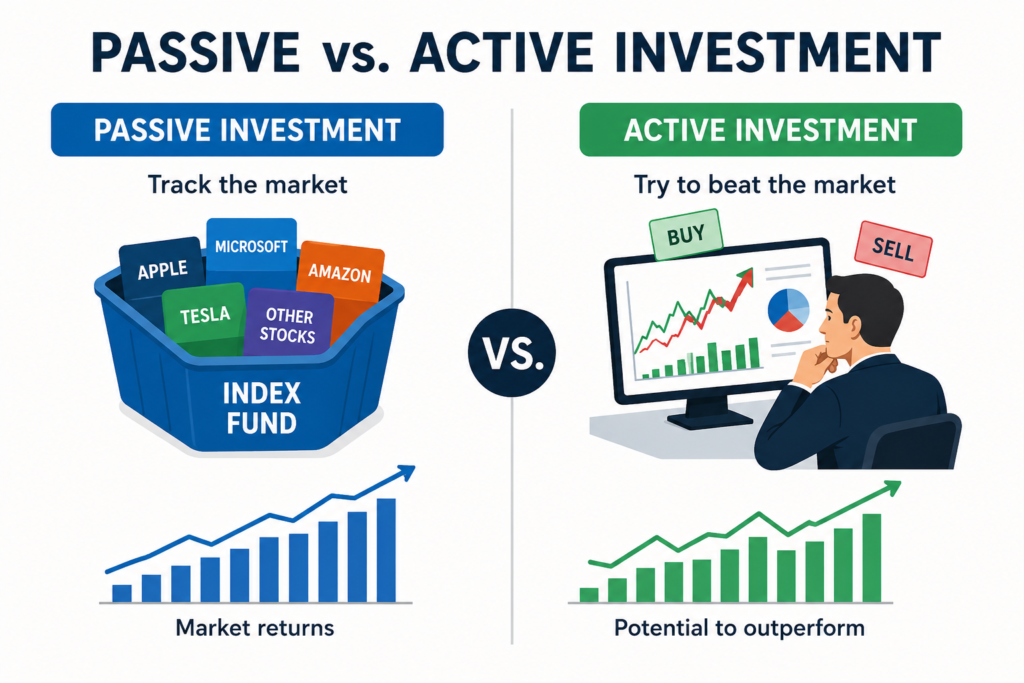
Active management puts a professional (or your own judgement) in charge of choosing which securities to hold, with the explicit goal of beating a benchmark. Passive management removes that layer of judgement entirely, aiming only to match the benchmark. The trade-off is straightforward: active investing offers the possibility of market-beating returns in exchange for higher fees and a wider range of possible outcomes; passive investing offers low, predictable costs and returns that track the market closely, with no realistic chance of beating it.
Why passive investing aims to match—not beat—the market
The logic rests on a well-documented pattern: most active managers, after fees, fail to beat their benchmark over the long run, and the ones who do are notoriously hard to identify in advance. Recent industry data shows only around a quarter of active funds have outperformed a passive alternative over ten years. Rather than gamble on picking that minority in advance, passive investing simply accepts the market’s average return which, history shows, is usually a perfectly good outcome, especially once the lower fees are factored in.
How Passive Investment Management Works
Investing through index funds
Traditional index funds (also called unit trusts or OEICs in the UK) are priced and traded once a day, after the market closes. You buy and sell at that day’s single price, and the fund publishes its holdings on a regular schedule.
Investing through Exchange-Traded Funds (ETFs)
ETFs achieve the same goal tracking an index but trade on a stock exchange throughout the day, just like an individual share. Prices move constantly during market hours, and most ETFs publish their full holdings daily, giving investors more visibility and more control over exactly when they buy or sell.
Portfolio replication strategies
Funds can replicate an index in more than one way, and the method a provider chooses affects both accuracy and cost.
Full replication vs. sampling methods
Full replication means the fund buys every single security in the index, in the exact weighting the index uses the most accurate approach, and the most practical one for indices with a manageable number of constituents, like the FTSE 100. Sampling (or optimised sampling) is used for indices with thousands of holdings, where buying every single one would be impractical or expensive; instead, the fund buys a representative subset chosen to behave as closely as possible to the full index, accepting a small amount of extra tracking error in exchange for lower trading costs.
Automatic portfolio rebalancing
Indices themselves change over time companies grow, shrink, get added, or get removed and passive funds rebalance automatically to keep pace, without any manager needing to make a discretionary call. The S&P 500, for instance, rebalances its weightings quarterly.
The role of fund managers in passive investing
There’s still a team behind every passive fund, but their job looks nothing like a stock-picker’s. Rather than researching companies and forming opinions, they focus on tracking accuracy, managing the mechanics of buying and selling as the index changes, controlling trading costs, and keeping the fund’s return as close to its benchmark as possible.
Popular Market Indices Tracked in the UK
FTSE 100: The 100 largest companies listed on the London Stock Exchange by market capitalization, the most widely quoted measure of the UK stock market, heavily weighted toward banking, energy, mining, and consumer goods giants with significant international revenue.
FTSE 250: The next 250 largest UK-listed companies below the FTSE 100 are often seen as a better barometer of the domestic UK economy, since its constituents are typically more UK-revenue-focused than the multinational giants of the FTSE 100.
FTSE All-Share Index: A combination of the FTSE 100, FTSE 250, and smaller UK companies, giving broad exposure to essentially the whole of the UK stock market in a single index.
MSCI World Index: A developed-markets index spanning 23 countries and around 1,320 constituents, heavily weighted toward the US. Over the past five years it has modestly outperformed the FTSE All-World index.
S&P 500 (for global diversification): 500 of the largest US-listed companies, selected by committee based primarily on market capitalisation. It’s currently the single most popular index among UK platform investors, and its top holdings Nvidia, Microsoft, Alphabet, and other major technology names carry substantial weight given the index’s market-cap approach.
Global and emerging market indices: The FTSE All-World index extends coverage to both developed and emerging markets as of late 2025 it held more than 4,250 constituents across 48 countries offering a single fund route to genuinely global diversification, albeit still with heavy exposure to the same large US technology names that dominate the S&P 500.
Types of Passive Investment Funds

Index Funds
Definition: A pooled fund, structured as a unit trust or OEIC, that replicates a chosen market index.
How they operate: Priced once daily after markets close; bought and sold directly through the fund provider or an investment platform rather than on an exchange.
Advantages: Simplicity, transparency about what the fund holds, and typically very low ongoing charges some UK providers charge less than 0.1% a year.
Typical investors: Long-term, buy-and-hold investors who value simplicity over intraday trading flexibility, including many workplace pension and regular-savings investors.
Exchange-Traded Funds (ETFs)
Definition: A fund that tracks an index but trades on a stock exchange like an individual share.
How ETFs differ from index funds: ETFs are repriced continuously throughout market hours, while index funds are priced once a day; ETFs typically also publish their full holdings daily, offering more transparency.
Trading flexibility: Because they trade like shares, ETFs can be bought or sold at any point during the trading day, and more sophisticated order types (limit orders, for example) can be used.
Liquidity benefits: Popular ETFs tracking major indices tend to trade with tight spreads and high volumes, making it easy to enter or exit a position without materially moving the price.
Target-Date Funds
How they automatically adjust risk: These funds are built around an expected retirement or goal year and automatically shift their asset mix reducing equity exposure and increasing bonds as that date approaches, without any action needed from the investor.
Suitability for retirement planning: Their “set and forget” design makes them a common default option within workplace pensions, since the fund’s risk profile is designed to match a saver’s shrinking time horizon automatically.
Multi-Asset Passive Funds
Balanced portfolios: These funds combine equities and bonds (and sometimes other assets) in a single product at a fixed or lightly managed ratio Vanguard’s LifeStrategy range, offered at various equity/bond splits, is a well-known UK example.
Automatic diversification: A single multi-asset fund can spread an investor’s money across thousands of underlying securities and multiple asset classes, doing in one purchase what would otherwise take several separate funds to achieve.
Benefits of Passive Investment Management
Lower investment costs: Because there’s no team of analysts picking stocks, passive funds cost a fraction of what active funds charge. UK passive fund fees have averaged as low as 0.14% a year, against roughly 0.75%–0.83% for many active alternatives.
Lower management fees: Over long periods, that fee gap compounds into a meaningful difference. A £10,000 lump sum growing at 4% a year for 20 years would reach roughly £21,500 in a fund charging 0.1% a year, but only around £19,000 in a fund charging 0.75%, a gap of nearly £3,000 from fees alone.
Broad diversification: A single global tracker fund can spread your money across many thousands of companies in dozens of countries, reducing the impact any single company’s troubles can have on your overall portfolio.
Simplicity: There’s no need to research individual companies or actively managed funds you’re simply buying exposure to an index you already understand, like “the UK market” or “the US market.”
Transparency: Index funds and ETFs publish their holdings regularly (many ETFs daily), so you always know broadly what you own, unlike some active funds where the underlying holdings shift without much visibility between reports.
Consistent long-term performance: Passive funds don’t guarantee gains, but they reliably deliver whatever the market itself returns, without the risk of a manager’s specific stock picks dragging performance down relative to the index.
Reduced emotional investing: Because a tracker fund’s holdings are dictated by the index rather than a manager’s (or your own) instincts, there’s less temptation to chase trends or panic-sell into a downturn.
Tax efficiency: Passive funds tend to trade less frequently than active funds, which can mean fewer taxable events for investors holding them outside a tax-advantaged wrapper though the biggest tax efficiency gains come from using an ISA or SIPP, covered in Section 11.
Easy portfolio maintenance: A small number of broad index funds or ETFs can form a complete, well-diversified portfolio that needs only occasional rebalancing rather than constant attention.
Suitable for beginner investors: The combination of low cost, broad diversification, and minimal ongoing decision-making makes passive investing a natural starting point for people new to investing.
Disadvantages of Passive Investing
Cannot outperform the market: By design, a passive fund will never beat its benchmark index at best it matches it, minus a small fee. If you’re specifically seeking market-beating returns, passive funds structurally can’t deliver them.
Limited flexibility: A tracker fund holds whatever the index holds, whether or not those holdings currently look attractively valued or overvalued there’s no scope to avoid a specific sector or company you have concerns about.
Exposure during market downturns: If the index a fund tracks falls, the fund falls with it in full there’s no manager stepping in to move to cash or defensive positions ahead of a downturn.
No defensive management during crashes: Unlike an active manager who might reduce risk heading into a downturn they anticipate, a passive fund stays fully invested according to the index, for better or worse.
Tracking error: Even well-run passive funds rarely match their benchmark exactly. Sampling methods, fund costs, and trading frictions all introduce a small gap, research has found some index funds underperforming otherwise comparable ETFs tracking the same index by around 42 basis points a year, almost entirely due to cost differences.
Less opportunity for tactical investing: Passive investing offers no mechanism to capitalize on a specific short-term view, a belief that one sector is about to outperform another, for instance since the fund simply follows the index regardless.
Index concentration risks: Market-cap-weighted indices can become heavily concentrated in a handful of dominant companies. Recent data shows the average S&P 500 index fund holding around 28% of its portfolio in just the seven largest technology companies meaning a tracker’s fortunes can hinge disproportionately on a small group of stocks.
Limited downside protection: Because passive funds don’t hold cash reserves or defensive assets as a matter of strategy, investors bear the full brunt of market declines with no built-in cushion.
Passive Investing vs Active Investing
Key Differences
Investment objective: Passive aims to match the market; active aims to beat it.
Management style: Passive is rules-based and mechanical; active relies on a manager’s ongoing judgement and research.
Costs: Passive funds typically charge well under 0.2% a year; active funds commonly charge 0.75%–1% or more.
Risk level: Passive tracks the market’s own risk profile exactly; active can carry additional risk (or, in principle, additional protection) depending on the manager’s positioning.
Expected returns: Passive returns should closely mirror the index, minus fees; active returns vary widely and, on average across the industry, tend to lag the index after costs only around a quarter of active funds have beaten a passive alternative over the past decade.
Tax efficiency: Passive funds’ typically lower turnover can mean fewer taxable disposals outside a wrapper; both approaches benefit equally from being held inside an ISA or SIPP.
Trading frequency: Passive funds trade only when the index itself changes; active funds may trade far more often as the manager adjusts positions.
Performance expectations: With passive, you should expect index-like returns, no more and no less. With active, you’re accepting a wider range of possible outcomes including the possibility of underperformance in exchange for the chance of beating the market.
Comparison Table
| Factor | Passive Investing | Active Investing |
| Objective | Match the market | Beat the market |
| Style | Rules-based, tracks an index | Manager-led stock selection |
| Typical fees | ~0.05%–0.2% a year | ~0.75%–1%+ a year |
| Trading frequency | Low only on index changes | Variable, often higher |
| Return profile | Closely tracks the index, minus fees | Wider range of outcomes; may under- or outperform |
| Downside protection | None built in falls with the index | Potentially some, depending on manager positioning |
| Best suited to | Long-term, cost-conscious, hands-off investors | Investors seeking a manager’s specific expertise or view |
Who Should Choose Passive Investment Management?
First-time investors: The low cost and simplicity make passive funds a forgiving place to learn the basics of investing without needing deep market expertise from day one.
Long-term investors: The strategy is built around riding out short-term volatility over years or decades, so it suits anyone with a genuinely long time horizon.
Retirement savers: Low ongoing charges matter enormously over a multi-decade savings horizon, since fees compound against you just as returns compound in your favour.
Busy professionals: A passive portfolio can be set up with regular contributions and left largely alone, appealing to anyone who doesn’t want investing to become a second job.
Investors seeking lower costs: Anyone prioritising cost efficiency above the (uncertain) chance of beating the market will find passive funds the more straightforward fit.
Investors with moderate risk tolerance: Multi-asset passive funds in particular allow investors to select a risk level from cautious to aggressive without having to build and manage that balance themselves.
Individuals building wealth gradually: Regular, disciplined contributions into a passive fund suit anyone building wealth steadily over time rather than looking for a quick win.
Popular Passive Investment Providers in the UK
Vanguard: One of the pioneers of index investing globally and a dominant name in the UK passive market, known for its Life Strategy multi-asset range and broad, low-cost index funds and ETFs, with some of the lowest average fund fees in the industry.
BlackRock (iShares): The world’s largest ETF provider through its iShares range, offering UK investors extensive access to FTSE 100, global, sector, and thematic ETFs.
Legal & General Investment Management: A major UK institutional and retail passive provider, with well-known trackers such as its UK 100 Index Trust and a strong presence in workplace pension defaults.
HSBC Asset Management: Offers a range of low-cost index and multi-asset funds, including popular global trackers such as its FTSE All-World index fund.
Fidelity International: Runs widely held index funds, including global tracker options that regularly feature among the most-bought passive funds on major UK platforms.
Amundi: Europe’s largest asset manager by assets under management, with a broad ETF range covering major global, regional, and thematic indices available to UK investors.
Tax Considerations for Passive Investors in the UK

Understanding Capital Gains Tax (CGT)
CGT applies to the profit made when you sell an investment for more than you paid for it, outside a tax-advantaged wrapper. For the 2026/27 tax year, the annual CGT exempt amount is £3,000 meaning gains up to that level in a tax year are tax-free with gains above that taxed at rates aligned across most assets including shares and funds. Investments held inside an ISA or SIPP are entirely outside CGT’s scope.
Dividend tax
Dividends received outside an ISA or pension are taxed once they exceed the dividend allowance, which remains £500 for 2026/27. Above that threshold, dividend income is taxed at 10.75% for basic rate taxpayers, 35.75% for higher rate taxpayers, and 39.35% for additional rate taxpayers rates that rose by two percentage points for basic and higher rate bands from the previous tax year.
Income tax implications
Interest-generating holdings bond funds and money market funds, for example, are taxed as savings income rather than at dividend rates, using the Personal Savings Allowance, so where you hold these investments can matter as much as which ones you choose.
Using Individual Savings Account (ISA) for tax-efficient investing
A Stocks and Shares ISA removes CGT, dividend tax, and the associated reporting complexity in one step: everything grown and earned inside the wrapper is entirely free of both taxes. For 2026/27, you can contribute up to £20,000 across your ISA allowances in a single tax year, and for most investors building long-term wealth through index funds or ETFs, filling the ISA is the natural first step before considering other accounts.
Investing through Self-Invested Personal Pension (SIPP)
A SIPP offers similar tax shelter to an ISA no CGT or dividend tax on holdings inside it plus tax relief on contributions themselves. Basic rate taxpayers effectively add 20% to every pound contributed via relief, higher rate taxpayers can claim back up to 40%, and additional rate taxpayers up to 45%. The trade-off is access: money in a SIPP is generally locked away until a set minimum pension age, unlike an ISA, which can be accessed at any time.
Annual tax allowances
The key 2026/27 figures worth knowing: a £20,000 ISA allowance, a £60,000 pension annual allowance (or 100% of earnings if lower), a £3,000 CGT exempt amount, and a £500 dividend allowance. Frozen thresholds elsewhere in the tax system mean more investors are being pulled into higher tax bands over time, which makes full use of these allowances increasingly valuable.
Record keeping for tax purposes
Investments held entirely within an ISA or SIPP require no reporting to HMRC at all. Outside those wrappers, you may need to file a Self Assessment return if your dividend income exceeds £500, your capital gains exceed the £3,000 exempt amount, your total disposal proceeds exceed £50,000 in a year (even where the net gain is smaller), or you receive Excess Reportable Income from accumulating ETFs held outside a wrapper so keeping clear records of purchases, disposals, and income becomes important for anyone investing outside an ISA or SIPP.
Risks of Passive Investment Management
Market risk: Because a tracker fund holds the market, it falls in full when the market falls there’s no cushion built in.
Inflation risk: Returns need to outpace inflation to grow your purchasing power in real terms; a period of high inflation and flat markets can erode wealth even while the fund’s nominal value holds steady.
Interest rate risk: Rising interest rates typically pressure both equity valuations and bond prices, and passive bond funds in particular can see their value fall as rates rise.
Currency risk: Global index funds hold assets priced in foreign currencies, so currency movements can add to or subtract from returns for a UK-based investor, independent of how the underlying companies actually perform.
Sector concentration: Market-cap-weighted indices can end up heavily skewed toward a handful of dominant sectors or companies technology names currently make up a substantial share of both the S&P 500 and the FTSE All-World index concentrating risk more than the number of holdings might suggest.
Liquidity risk: Niche or thinly traded ETFs can have wider bid-offer spreads and be harder to sell at a fair price during periods of market stress, even though most mainstream index trackers are highly liquid.
Tracking error: As covered in Section 7, no passive fund replicates its index perfectly, costs, sampling methods, and trading frictions all introduce a small but real gap between fund and benchmark performance.
Economic downturns: A passive fund offers no mechanism to reduce exposure ahead of a recession or crash, it simply rides the downturn down, then rides the recovery back up, for investors who stay invested.
How to Start Passive Investing in the UK

Step 1: Define your financial goals
Decide what the money is for and when you’ll need it for retirement in 30 years, a house deposit in five, or general long-term wealth building since your goal shapes everything that follows.
Step 2: Assess your risk tolerance
Think honestly about how you’d react to a 20% or 30% fall in your portfolio’s value, and how much time you have to recover before you need the money. This shapes how much you hold in equities versus bonds or cash.
Step 3: Choose a suitable investment platform
UK investment platforms vary in their fee structures, fund ranges, and account types (ISA, SIPP, general investment account). Compare platform fees alongside fund costs, since both eat into your long-term return.
Step 4: Select index funds or ETFs
A single global tracker (covering developed markets, or developed plus emerging) can form the core of a simple portfolio; more experienced investors might layer in regional or sector-specific trackers around that core.
Step 5: Open an ISA or SIPP if appropriate
Given the tax advantages covered in Section 11, most UK investors should aim to hold their passive investments inside an ISA, a SIPP, or both, rather than a general investment account, wherever their allowances allow.
Step 6: Invest regularly through pound-cost averaging
Contributing a fixed amount on a regular schedule monthly, for example, means you automatically buy more units when prices are low and fewer when prices are high, smoothing out the impact of trying (and likely failing) to time the market.
Step 7: Review and rebalance periodically
Even a passive portfolio needs occasional attention checking once or twice a year that your mix of equities, bonds, and other assets still matches your intended risk level, and adjusting if market movements have shifted it out of line.
Best Practices for Successful Passive Investing
Invest for the long term: Passive investing is built to reward patience over years and decades, not weeks or months short holding periods undermine the entire premise of the strategy.
Keep investment costs low: Every basis point saved in fees is a basis point added directly to your return, compounded over your entire investing horizon.
Diversify globally: Relying on a single country’s market including the UK’s own concentrates risk unnecessarily when global trackers make broader diversification just as easy.
Avoid emotional decisions: Resist the urge to sell during downturns or chase whatever’s performed best recently; both instincts tend to work against long-term returns.
Reinvest dividends: Automatically reinvesting income rather than withdrawing it lets compounding work at full strength over time.
Review your portfolio annually: A yearly check-in is usually enough for a passive portfolio confirming your asset mix, contributions, and goals are still aligned.
Stay disciplined during market volatility: Downturns are a normal, recurring feature of investing, not a signal that something has gone wrong with your strategy.
Continue investing consistently: Regular contributions, maintained through both rising and falling markets, tend to outperform sporadic, emotionally timed lump sums over the long run.
Common Passive Investing Mistakes to Avoid

Trying to time the market: Attempting to buy at the bottom and sell at the top consistently fails even professional investors. A disciplined, regular contribution schedule outperforms guesswork over time.
Frequently switching funds: Chopping and changing between similar trackers rarely improves returns and often just adds trading costs and tax complications.
Ignoring investment fees: Even passive funds vary in cost; overlooking a seemingly small fee difference can cost thousands over a multi-decade investing horizon.
Failing to diversify: Concentrating in a single index, sector, or country undermines one of passive investing’s core advantages.
Chasing short-term performance: Buying whatever index or fund performed best last year is a poor predictor of what will perform best next year.
Panic selling during downturns: Selling after a fall locks in losses and forfeits the recovery that has historically followed every major market downturn.
Investing without clear goals: Without a defined purpose and time horizon, it’s hard to choose an appropriate risk level or know whether your portfolio is actually on track.
Neglecting portfolio reviews: Even a low-maintenance passive portfolio drifts out of its intended balance over time without at least an occasional check-in.
Holding excessive cash: Cash sitting on the sidelines misses out on long-term growth and loses real value to inflation over time.
Forgetting tax-efficient investment accounts: Building a portfolio in a general investment account when ISA or SIPP allowance remains unused leaves tax savings on the table unnecessarily.
The Passive Trade-Off: Lower Returns’ Certainty for Higher Returns’ Chance
Passive investment management trades the promise of beating the market for the near-certainty of matching it, at a fraction of the cost. That trade has proven remarkably durable: UK assets managed passively have grown from around a fifth of the total in 2005 to over a third today, and the reasons are structural rather than fashionable low fees compound in an investor’s favour over decades, broad diversification spreads risk sensibly, and the alternative picking active funds capable of consistently beating their benchmark after costs has proven difficult even for professionals.
None of that makes passive investing risk-free. It offers no defensive management during a crash, no way to sidestep an overvalued sector, and no guarantee of positive returns over any given period, the value of your investment can still fall as well as rise. But for long-term investors willing to accept the market’s own risk and return profile in exchange for simplicity and low costs, it remains one of the most straightforward, well-evidenced routes to building wealth over time.
The practical takeaway is consistency: define your goals, choose a sensible mix of low-cost index funds or ETFs, hold them inside an ISA or SIPP wherever possible, keep contributing on a regular schedule, and resist the urge to tinker when markets get volatile. Built and maintained this way, a diversified passive portfolio can quietly do its job in the background while you get on with everything else.









Leave a comment