


Saving alone is no longer sufficient for building long-term wealth. Inflation steadily erodes the purchasing power of cash and low-interest savings accounts, making passive savings counterproductive in today’s economy. Strategic investment management addresses this challenge by enabling individuals and businesses to grow capital, preserve wealth, and achieve their financial objectives with greater efficiency.
Investment management is the professional or systematic process of overseeing financial assets to meet specific long-term objectives. Whether you are an individual saving for retirement or a corporation managing capital reserves, investment management provides the structure, discipline, and strategy required to turn financial resources into lasting prosperity.
The process involves analyzing markets, selecting investments, and managing portfolios strategically to align with each client’s objectives.
This guide equips you with everything needed to take control of your financial future. You’ll discover what investment management is and why it works, explore the strategies and vehicles that generate wealth, and follow a clear roadmap to build a successful investment portfolio that actually works for you.
What Is Investment Management?

Investment management transcends the mechanics of buying and selling securities. It’s a strategic alignment process translating your financial priorities into actionable investment decisions that deliver measurable outcomes. By understanding your risk tolerance and financial goals, investment management enables you to construct a tailored portfolio and maintain it through disciplined rebalancing, ensuring your investments remain strategically positioned regardless of market volatility.
Key Objectives of Investment Management
- Wealth Creation: Growing the absolute value of your assets over time.
- Capital Preservation: Protecting your base investment from significant loss.
- Income Generation: Producing consistent cash flow (e.g., dividends or interest) from assets.
- Risk Management: Navigating market volatility to minimize exposure to catastrophic loss.
Why Investment Management Is Important

Successful investment management can significantly improve financial outcomes and help investors navigate uncertain economic conditions.
1. Alignment with Financial Objectives
Whether you are saving for a home, planning for a comfortable retirement, launching a business, or funding education, a structured investment strategy provides a clear roadmap. This intentional approach significantly increases the probability of reaching your milestones on schedule.
2. Inflation Hedging
Inflation acts as a silent erosion of purchasing power. Capital held in low-interest accounts often loses value in real terms over time. Professional investment management focuses on asset growth that consistently outpaces inflation, preserving and enhancing the real value of your wealth.
3. Promotion of Disciplined Planning
Successful investing requires a transition from emotional, short-term reactions to long-term, objective-driven decision-making. A formal management plan helps insulate your portfolio from the noise of market volatility and prevents impulsive actions driven by fear or speculation.
4. Mitigated Risk Exposure
Diversification and strategic asset allocation are the cornerstones of risk management. By balancing your portfolio across various asset classes, industries, and geographies, you reduce exposure to the volatility of any single investment, smoothing out the journey toward your goals.
5. Pathways to Financial Independence
Consistent, long-term portfolio management is a primary engine for building wealth. By compounding returns and creating reliable streams of passive income, investment management serves as a foundational tool for achieving true financial independence and long-term security.
Types of Investment Management

Different investment management approaches suit different investors depending on their objectives, knowledge, and risk tolerance.
Active Investment Management
Managers research markets and hand-pick individual investments, aiming to generate returns that exceed the market benchmark. The appeal is straightforward, the potential for outperformance.
However, the track record is sobering, only 21% of active funds outperform their passive counterparts over 10-year periods. Additionally, active management fees typically range from 0.2% to 2% annually, significantly higher than passive alternatives.
Active managers also generate more trading activity, which can trigger higher capital gains taxes and further erode net returns.
Passive Investment Management
Rather than trying to beat the market, passive strategies own the market. By holding all (or representative samples of) securities in an index, they deliver market-level returns at minimal cost (averaging 0.11% annually). The simplicity and tax efficiency make this the default choice for most long-term investors, though you sacrifice any chance of outperformance during market cycles.
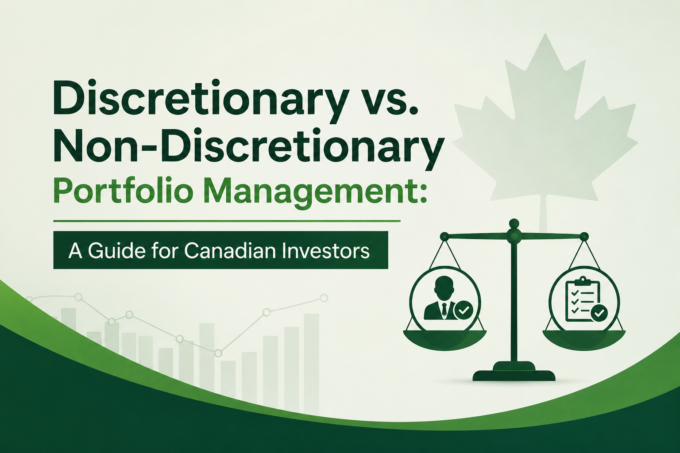
Discretionary Investment Management
You grant your advisor written authority (documented in an Investment Policy Statement and power of attorney agreement) to execute investment decisions without seeking approval for each trade. Within pre-agreed parameters risk level, asset allocation bands, eligible investments the advisor can trade, rebalance, harvest tax losses, and adjust allocations immediately as markets shift. This model assumes the advisor’s judgment is sufficiently trustworthy that requesting approval for every transaction adds no value. The advantage: faster execution and nimble response to market conditions. The requirement: clear guardrails defining what the advisor can and cannot do.
Non-Discretionary Investment Management
You retain veto power over all material decisions. Your advisor recommends actions “we should rebalance toward bonds” or “we should shift from Manager A to Manager B” but nothing happens until you approve. This preserves maximum control and governance independence but demands active participation: you must be available to evaluate recommendations and make timely decisions. In volatile markets, delays can be costly.
Major Investment Options

A well-constructed portfolio typically combines multiple asset classes, each serving a distinct purpose. Here’s what each brings to your portfolio:
Stocks
When you own stocks, you own fractional shares of real businesses. Historically, stocks have returned about 10% annually far outpacing inflation and other investment types. The trade-off is volatility, stock prices fluctuate daily based on company performance, economic conditions, and investor sentiment. For long-term investors who can tolerate temporary declines, stocks are essential.
Bonds
Rather than owning companies, bonds mean you’re lending money to governments or corporations. In return, they pay you interest (typically 2-5% annually). Bonds don’t offer the growth potential of stocks, but they’re more predictable and stable particularly valuable during market downturns when stocks decline. In portfolio terms, bonds are insurance.
Mutual funds and Exchange-Traded Funds (ETFs)democratize diversification.
Instead of buying 20 individual stocks (and managing them), a single mutual fund or ETF purchase gives you exposure to hundreds of securities.
The difference: ETFs trade like stocks and typically cost less than mutual funds (averaging 0.05-0.3% versus 0.5-1%). If choosing between active and passive, the data is clear: passive index funds charge lower fees (0.11% average) and beat 79% of active managers over 10-year periods.
Real Estate Investments
Some investors buy rental properties collecting monthly rent (typically 3-5% annual yield) while benefiting from long-term property appreciation (3-4% annually). However, direct real estate requires significant capital, active management, and patience, selling takes 47-69 days. For others, Real Estate Investment Trusts (REITs) provide real estate exposure through liquid, traded funds. The largest REIT ETF (VNQ) holds 145 real estate companies and offers yields around 2.7-3.4% making real estate accessible without property management.
Alternative Investments
Commodities (gold, oil) hedge inflation. Private equity offers high growth potential but requires long lockup periods and significant capital. Hedge funds employ sophisticated strategies but often underperform despite high fees. Cryptocurrency offers speculative opportunity with extreme volatility. Most investors keep alternatives at 0-10% of their portfolio for specialized needs only.
The Investment Management Process

A professional investment process is not a one-time event; it is a disciplined, repeatable cycle designed to move you toward your financial destination. By adhering to a structured approach, you remove guesswork and replace it with a rigorous strategy.
Step 1: Define Your Objectives
Clarity about what you’re investing for is foundational. Establish specific goals (amount, timeline, liquidity needs) for retirement, education, home purchase, or wealth building. These objectives shape all subsequent decisions.
Step 2: Assessing Risk Tolerance
Risk tolerance has two dimensions: Emotional (your psychological capacity to endure volatility) and Financial (your ability to absorb losses without compromising objectives). Your true tolerance is the lower of the two. A structured risk tolerance questionnaire typically results in a recommended percentage allocation to each asset class.
Step 3: Asset Allocation
This is the most critical driver of portfolio performance. The way you divide your investments among stocks, bonds, real estate, and other assets is one of the most important factors in determining your long-term investment success. The right mix depends on your financial goals, risk tolerance, and investment time frame. To stay focused and disciplined, it is a good idea to document your strategy in an Investment Policy Statement (IPS), a written plan that outlines how your investments will be managed over time.
Step 4: Portfolio Construction
Once you have decided on your investment mix, choose specific investments such as index funds, ETFs, or bonds to match your plan. Focus on investments with low fees, good tax efficiency, and broad diversification to help reduce risk. Keep your portfolio simple and easy to manage, as well-diversified index funds often deliver better long-term results than overly complicated investment strategies.
Step 5: Portfolio Monitoring and Rebalancing
Over time, market movements can cause your portfolio to drift away from its original investment mix. For example, if stocks perform much better than bonds, they may make up a larger portion of your portfolio than intended. To keep your investments aligned with your goals and risk level, review your portfolio regularly and rebalance it when needed. A good practice is to check your portfolio every quarter and make adjustments whenever an asset class moves significantly away from your target allocation. This helps maintain the right balance between risk and return over the long term.
Key Investment Management Strategies
Beyond selecting the right asset classes, successful investment management relies on four foundational strategies that have consistently generated wealth over decades. Here’s what the research shows about each:
Diversification
Don’t put all your eggs in one basket. Spread investments across different asset classes (stocks, bonds, real estate), geographies (U.S., international, emerging), and sectors. Portfolio diversification had its most decisive victory in 2025 when U.S. stocks faced tariff uncertainty. Non-U.S. stocks fared better, and gold surged nearly 70%, demonstrating diversification’s power in turbulent markets. Most investors need exposure to only three core asset classes: U.S. stocks, international stocks, and investment-grade bonds.
Dollar-Cost Averaging
This strategy involves investing a fixed amount at regular intervals regardless of market conditions. Invest fixed amounts at regular intervals. However, research shows lump sum investing outperforms approximately 70% of the time because markets trend upward. Use DCA if you lack a large sum upfront or want psychological comfort. If you have capital available, deploy it immediately.
Value and Growth
- Value: Undervalued, established companies with income. Outperform during downturns (3-5 year returns)
- Growth: High-growth companies with premium valuations. Outperform during bull markets (7-10 year returns)
Growth stocks tend to outperform during bull markets, fueled by investor optimism. Value stocks often provide relative stability during downturns. Most investors benefit from blending both.
Long-Term Investing
Holding quality investments for decades lets compound interest work its full magic. An investor who started with just $10,000 at age 31 and never touched it for 20 years ends up with nearly 50% more wealth than someone investing $2,000 annually for 10 years starting a decade later despite the second investor contributing more total capital. The power isn’t the individual returns; it’s decades of returns earning returns on returns.
Research shows the S&P 500 never had negative returns over any 20-year rolling period since 1936. Market downturns are temporary. Long-term investors who stay the course always win.
Common Risks in Investment Management

Every investment carries risk. Understanding these risks helps investors make informed decisions.
Market Risk
The broader market is declining and affecting your portfolio. While you cannot eliminate market risk, diversification across asset classes, sectors, and geographies reduces your exposure to any single downturn.
Inflation Risk
Your investment returns fail to keep pace with rising prices, eroding purchasing power over time. Combat this by maintaining a portion of your portfolio in growth oriented assets (stocks, real estate) that historically outpace inflation.
Liquidity Risk
Being forced to sell an asset at an unfavorable price due to difficulty finding buyers. Mitigate this by keeping an accessible emergency fund in cash or near cash investments, allowing you to avoid distressed sales of longer-term holdings.
Interest Rate & Credit Risk
Bond values fluctuating with interest rate changes, and borrowers defaulting on obligations. Manage this by regularly reviewing credit ratings of issuers and adjusting bond duration (shorter duration bonds are less sensitive to rate changes) based on your interest rate outlook.
“Risk isn’t something to avoid entirely, it’s inseparable from returns. Smart investing is about identifying which risks you’re taking on and ensuring they’re intentional, understood, and appropriately managed”
Investment is a discipline, not a gamble.

Investment management is far more than simply buying stocks or investing money. It is a structured approach to growing, preserving, and managing wealth while balancing risk and return. It’s neither something you set aside and ignore, nor a high stakes guessing game. Rather, it’s a deliberate, strategic process of deploying your capital in service of your life whether that’s early retirement, a home, education for your children, or financial independence.
The path forward requires three things: clarity about your goals, honesty about your risk tolerance, and patience to stay the course. Markets will rise and fall. Headlines will shift. Your job is to maintain perspective, stick to your plan, and let compound growth work in your favor over decades, not weeks.







Leave a comment